Author: monikablichar

Monika Anna Blichar was born in Latina, Italy in July, 1982. After immigrating to Canada in the early 1980’s, the family lived in Red Deer, where they bore a second daughter, and then moved west to B.C. in 1996. Monika has completed a B.A. in English and French from the University of Victoria and has also obtained a teaching credential with the B.C. College of Teachers. Primarily self taught, she has also studied art at Camosun College where she learnt various techniques and strategies in creating contemporary pieces. She continues to pursue creative projects and is exploring various professional opportunities in the arts which include body painting and events coordination. Her interests include the Humanities, writing, traveling, and being outdoors. Art has played a significant part of Monika’s life and continues to be an expression of her flowing imagination, appreciation for beauty, and a reflection of seeing beyond the obvious. Monika is currently living and working in Vancouver, B.C. She is the owner of MAB Ventures Inc., An Arts & Entertainment Agency, and is President of Make and Break Arts Foundation. Her notable projects and initiatives include founding Art World Expo, Diamond Dolls Women's Networking Group, MAB Arts Studio & Boutique Gallery and THE FAB Art Program.

Artist Vicki Rae at Art World Expo 2014

Accomplished artist Vicki Rae joins Monika Blichar in studio for a candid interview about her craft.

ART WORLD EXPO TM Proudly Presents: Artist Vicki Rae

Vicki currently lives and works in New Westminster, BC. She received formal training at the Lorenzo di Medici Art Institute in Florence, Italy and is otherwise ‘self taught’.

A Vancouverite with Native Canadian and South African roots Vicki has explored various themes such as SAFARI and other wildlife subjects, dance and human experience, spirituality and psychology.

Using a striking, vivid pallet, expressionism and the full spectrum of human emotion Vicki’s body of work honours and embraces the light and the shadow, and en masse, is a captivating visual journal of her life and experiences.

“Employing intuition as a guide and raw emotion as fuel, I give all of myself to my Art. I engage with each piece, as if in a dance, and allowing the painting to lead me I aim to reveal it’s unique energy, it’s voice and the story it has to tell.”

For more information about Vicki, please visit:
https:/www.vickirae.com

Art World Expo TM tickets are available online:
http://artworldexpo.eventbrite.com/

By Phone: 1 604 999 6177

Email: artworldexpo@gmail.com

Event Information, Applications and Artist Interviews:
https://artworldexpo.wordpress.com/

Connect on Social Media:
https://www.facebook.com/ArtWorldExpo
https://twitter.com/ArtWorldExpo

2014 Theme: CIRCUS!
“Life’s A Circus, Enjoy the Show!”
Don’t forget your Top Hats and Clown Costumes!

Art World Expo is an annual fine art show and sale representing local and international artists of all mediums. The event was founded by Monika Blichar in Vancouver, BC in 2010 and is held at Telus World of Science the first Friday of May each year. For more information about Monika Blichar for MAB Ventures Inc. including information about MAB Art Studio & Boutique Gallery, please visit: https://www.monikablichar.com 

Meet Catherine Coulter-An Artist Finding Common Ground to Communicate

Interview With . . . 

Catherine Coulter

by Alyssa Laube 


About: After a ten year break from journalism, Catherine Coulter is making her grand return to writing and the arts. She focuses on photography and writing, but has a wide variety of other hobbies and interests. You can view Catherine’s work at: 


http://catherinecoulter.wordpress.com/


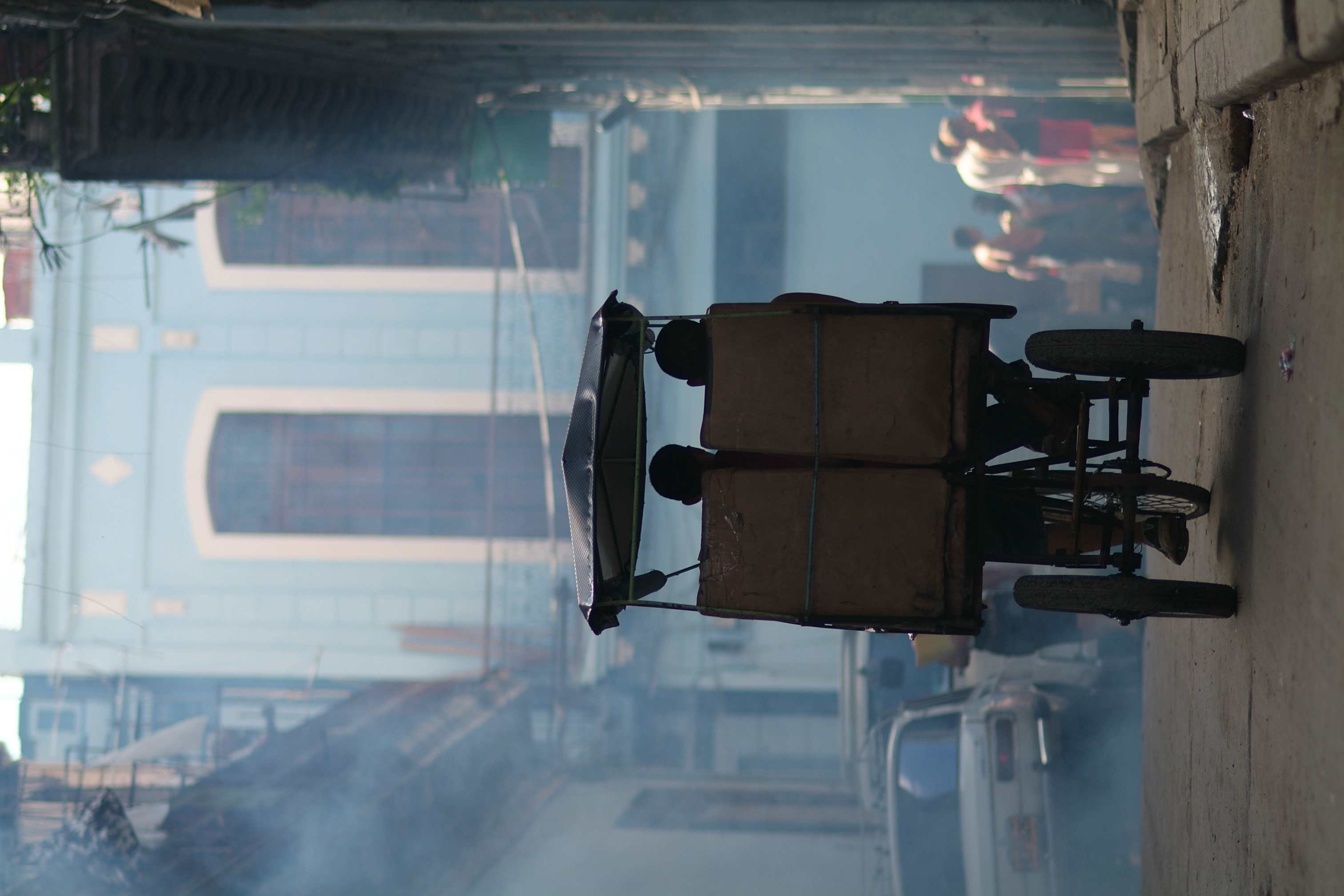
DSC_4422    final vignette Dawn Rickshaw

In the past, you worked as a journalist. What was that like? (i.e.: who you worked for, what you wrote about)

I wrote for the North Shore News but my first position was at the Williams Lake Tribune. I was staff at those two papers but I freelanced for a number of other newspapers and magazines. I covered court, fashion, school board, sports, food and wine: that’s the beauty of a community paper – a reporter gets to try everything! (Note: this is weird. I’ve never been interviewed before.)


What encouraged you to move on from journalism?

Seeing myself satisfied personally and professionally in the future.


Could you tell me about the 10-year break you took from it?

Marriage, motherhood, travel, philanthropy, personal and spiritual growth.


In this time, did you stop writing completely? How did you get your creative fix? 

I wrote journals for years, and experimented with my photography, trying different kinds of cameras and using a lot of film.


Are you glad that you took that break? What came from it?

I’m glad I stopped writing for newspaper. I missed the human interest stories, but writing news did and does not fit my character.


What encouraged you to come back to it? 

Basically working away at myself emotionally and discovering what really makes me happy!


Please tell me about your trip to Turkey! How did it effect you?

Just seeing the word Turkey makes my heart burst! I turned 40 the day I landed in Istanbul this past November. I was ready for a journey alone and 40 seemed the perfect ‘excuse’. I experienced a real upheaval in my life a few years prior and it was the first opportunity since that that I got to be alone, process and heal and I did so by writing and taking pictures. There were moments on that trip where I would be sitting with my journal on my lap, my cameras lying around me, my cheeks would be flush and my boots dusty from a day of hiking and photographing, and I knew I was just where I should be doing what I should be doing. That feeling is incredibly powerful and I came home wanting to share it with everyone. And, eventually, provide an opportunity to host similar trips (stay tuned).


Before your work as a journalist, what jobs did you have? 

Terrible waitress and amazing nanny!


What hobbies have you had throughout your life and in present day? How did they shape who you are? 

I’ve played on the same soccer team for 15 years. My son and I are avid skiers. I hike. We love our cruiser bike rides in the summer (my Mothers Day gift to me a few years ago: a 1968 Schwinn Starlet!), being in and on the water, spending as much time with our friends and family doing anything and nothing. We are blessed. I am what my life is today.


Why did you start each of them? 

Landing in India at 22 years old was the catalyst for everything.


As a book lover, which ones are in your top 3? Which are you reading right now? 

Eek! Top 3?! How about top 30?! Currently, I’m reading The Rise, Annabel,  Diary of a Wimpy Kid and Captain Underpants (my son is 7!).


How have books changed you as an artist? 

Oh good question! Visualization.


Why do you believe you love stationary, letters, and other sentimental objects?

Letter writing is art to me – its expression and its thought. The process of choosing a beautiful piece of paper – the colours and textures – then scrawling across it with an ink pen…So beautiful! Plus, the feeling it gives someone to receive something so carefully prepared for them. I will never forget what it looks like or how it feels to see my Dad’s handwriting – it’s like being close enough to smell the soap he uses.


How would you describe yourself as a person and an artist? How do these descriptions compare?

There’s no difference in the two. Compassion, full of love and humour, quirky and rooted, curious.


Why do you love photography? Writing? 

They are both so intimate to me, and give me an opportunity to express and explore myself safely, clearly and without criticism or judgement (until now, of course!).


Do you have any training in either of these fields? 

I attended Western Academy of Photography and Journalism on Vancouver Island.


How are the two different, in as many ways as possible? How are they the same? 

I suppose to me it’s like watching a movie and reading the book. The story is being told in two different ways yet if done well each should be as visual as the other. So, although they are different ways to tell a story, a story is still being told.


Other than signing up for the expo, how are you practicing leaving your comfort zone? 

I feel like I’ve put an invitation out there that leads directly inside. To reach my goal, which is helping other women with growth through art and travel, it’s important I’m available and a bit vulnerable (my M.O.: lets all get comfortable with vulnerability!).


What are you hoping to gain from this year’s expo? 

Monika (Blichar) has been an amazing source of inspiration and encouragement for me (and many others) so it’s really about goals and fulfillment, and getting past some insecurities. She asked me a few months ago, “If money is no object, what do you see yourself doing?” It was such an easy question for me to answer that I hadn’t put to myself.


As a photographer, what do you like to focus on? 

People in their environments.


Which effects do you like to use? 

Well I don’t really use any actually. The reason I love film is because, if you haven’t gotten the right exposure and focus well that’s that. It’s tough to recapture the original moment. I love holding my breath getting film back thinking ‘Oh crap. This will be awesome or it’s $50 down the drain!’ And I have had some amazing results and some seriously disappointing ones. With the exception of a couple of iPhone snaps I basically came home with zero pictures from last year’s spring break in Mexico. I had taken only my mini Diana and my film was tangling up like nylons out of a washing machine – so much for cataloging that trip for my son! It’s the same for digital though. I’m fairly challenged when it comes to electronics/technology. My strengths lie in my ability to connect with all kinds of people no matter what their background.


Do you often have a message incorporated into your photography?

There’s a theme, for sure. I’m fascinated by women in their environments. In school, I did a photo essay of an exotic dancer – I still find those pictures interesting. I photographed her getting ready and a small part of the performance, literally one or two shots before I wrapped it up. (The performance wasn’t telling the story though, in my opinion.) I’m always amazed that, if we truly want to, despite our differences – religious, cultural, language barriers – we can find some common ground or ways to communicate. Whether its through our children, a broken heart, an illness, or passion for travel or art or music, a great success, literature, or a few bottles of wine and a dance off!


How did your childhood influence you as an artist? 

Everything has brought me to where I am now, both good and bad, and has taught me to be observant, interested, thoughtful and sensitive.


What do you hope to do in the future, both in your personal and professional life? 

“Keep on keeping on like a bird that flew…”- B. Dylan

photo


Bill Stewart-Revealing a Perspective for Trees with Green Branch Decor

Interview With…

Bill Stewart 

by Alyssa Laube

greenbranchdecor greenbranchdecor2 greenbranchdecor4 greenbranchdecor5

About: I’ve lived my life on small acreage in Abbotsford. B.C. I spent the first five years of my working life in reforestation, where a handful of friends and myself did tree planting and juvenile spacing. We would often take all our gear and supplies with us and make our own camp with plastic and tarps, and not come out for a week or so – a somewhat appealing thing to do, especially in a person’s youth – spending time in the mountains and helping in the regeneration of the forest. Juvenile spacing in reforestation is where an established plantation of either planted or naturally seeded trees are too crowded, so  the density is thinned to a tree every eight or ten feet. Even though we had moved from our rudimentary camps to staying in logging camps and motels, the often inclement weather, and not uncommon assaults from mosquitos, no-see-ums, and black flies, and the isolation, all begins to wear on a person, so I decided to go farming and have been doing that since. I use to keep livestock, but quit doing that in 2004, when I started a new endeavour in trying to grow European truffles. I’ve had some successes  – in 2013 I harvested the first verified Perigord truffles grown in Canada, buy I haven’t yet produced enough to say the venture has been a success. Shortly after I  started the truffles was when I started thinking about growing trees for artwork.  A recent change in my life came two years ago when I got diagnosed with cancer. Even though I had always been health conscious, after the diagnosis  my wife Kathi and I went on a vegan diet – something we are both enjoying. It’s not an uncommon paradox that something that isn’t good can lead to something good.

For more information about Bill’s work, please visit http://www.greenbranchdecor.ca

Your work is centralized around trees. Why did you choose to use them as a medium and what gave you the idea to use them in art? 

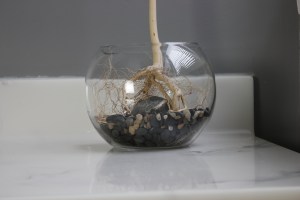
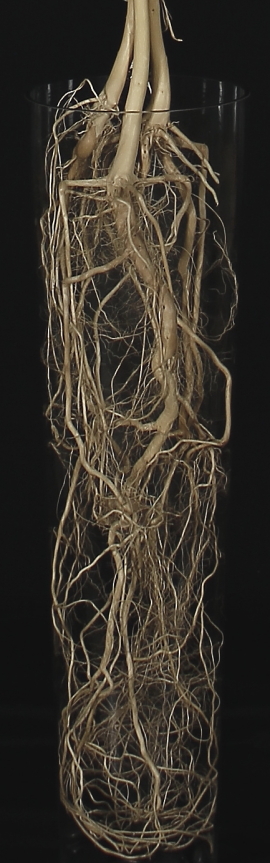
The reason I chose trees is largely because it gave me the opportunity to accomplish two things at once – give me something to grow, and provide a medium for creative purposes. It started first with the need and desire to grow something. Having grown up on a small acreage where our family always had big gardens, a person acquires a desire for growing and nurturing plants. I had a number of empty spots on my farm and was looking for a something to grow in them, so I started thinking about a few trees to fill in the spaces. About the same time, I was doing a couple of small jobs on the farm. The first was when I was picking up some cedar branches I had pruned from a tree, and the idea came to me that instead of burning them, perhaps I could find a use for them. On a whim more than anything else, I decided to try to peel them, and found them to peel quite easily, and that they were also very appealing, with their fine branching and the brightness that resulted from the bare wood. Shortly after that I was doing some weeding and I pulled a young maple tree out of the ground and noticed how substantial and interesting the roots were. That got me thinking about the roots of trees and how their size, shape and character are to a large extent unknown, even though they can be equal in mass to the part of the tree above the ground. So I wondered if roots of trees could also be peeled, intact with the top of the tree, to create art from the trees. The more I thought about it, the more ideas I came up with. So I came to the conclusion that I would grow trees in those empty spots on my farm , and use the trees as a medium for artwork.

What makes working with wood different from other materials?

This is my first real endeavour at creating objects of art, so I haven’t really used other materials in artwork. But having said that, there are some things about wood that can be adventitious. The first is the many ways that wood can be shaped. The list of the potential shaping tools for wood would be very long – from simple tools through sophisticated electric tools, fire, water, and even other organisms. And the many ways wood can be finished and transformed also offers a very wide range of possibilities – from nothing at all, through painting, staining and dyes, and yes, fire, water, and other organisms. Another potential benefit of wood can be the uniqueness and strong characteristics of an individual piece. And the relative innocuousness of wood, and often pleasing tactility  aspect of wood is a bonus.

Do you remember the first time you found your interest with trees or nature? 

I can’t remember the first instance I developed an interest with nature, but I’m sure it was at a very young age. I have many early recollections of spending a lot of time outdoors. Growing up with gardens, pastures, and bush, it would be hard not to observe, admire, and become interested in nature. As for trees specifically, as a kid I climbed many a tree – mostly just for the fun of it, or for picking some choice fruit, or even for harvesting cascara bark.

What do you hope to accomplish with your work? 

I think that my work can reveal a perspective of trees that is not always appreciated. The removal of the bark is like an unveiling – highlighting and showcasing the intricacies of the tree’s wood, and with the peeled cedars, the intricacy of their fine branching. This highlighting accents the shape of the tree, revealing how the tree is always trying to reach outward and upward in it’s quest for growth. This in turn can be translated and compared to a person’s or a community’s strive for the same growth. And my work with roots opens up a host of other symbolisms, such as anchoring, bonding, and nourishment.

Please explain the following concepts and how you use them: ikebana, bonsai, Feng Shui and Japanese Zen.

I’m far from being an expert on either of those subjects, but like with many things, there are threads of commonality running through each of those concepts – and with my work. In the case of ikebana the similarities  with my work are the use of different parts of a plant to draw attention to shapes and lines, the use of minimalism, and  often a suggestion or evocation of a certain meaning, usually to draw humanity closer to nature. With bonsai and my work, the obvious connection is the use of trees. In bonsai the trees are kept small through judicious pruning of both the crown and the roots of the tree, and even though the end objective of my work is very different, I have to employ many of same techniques. The main artistic concept of bonsai that I try to emulate, is to reveal the essence of the tree. Feng Shui is a very complex art form that emphasizes  the harmonization of people with their environment, and it is that principle that that I try to bring into my work. Japanese Zen is about balance, harmony, and relaxation, and is associated with minimalism, simplicity, and purity of lines. Although a tree in nature may strive for balance, harmony, and relaxation, the forces of nature does not always allow it to achieve that objective. And a tree certainly is not always about minimalism, simplicity, and purity of lines. When working with my trees I can choose to show the tree in either state – balanced, relaxed, simple – or the reverse – struggling and stressed out.

Why do you peel wood rather than sand it and how does peeling wood impact your works?

The peeling allows a lot of character and detail to remain on the wood, and if I get the timing of the peeling right, the resulting surface of the wood is  very smooth with a natural sheen. The peeling also avoids some of the dust that comes with sanding, though the peeling can also be kind of messy. The fine branching of the cedars I peel could not be retained with sanding – it would be impossible to sand off the bark and still have any wood left.

Have you done any works with the bark on, sanded, etc.? Would you consider it?

I do have a few pieces with the bark on, but I find  the pieces with the bark on to be very uninspiring, so I avoid them. If I have a piece of wood that is proving to be too difficult to remove the bark, it may end up in the scrap pile. Sometimes I will paint pieces that I purposely left the bark on. With regard to sanding, I do sand a little – to remove any bits of bark that may remain, or remove any other marks on the piece, and working with the roots requires quite a bit more cleanup and sanding to remove bits of bark and loose frayed wood.

What are the themes in your art? 

The themes in my work is to show how a tree can be seen as a representation of energy, enthusiasm, perseverance, and be solidly grounded and anchored.

How do you use sculpturing? 

In my work sculpturing consists of shaping the trees when they are growing and in preparation of a final piece. The most obvious and most expected place this is seen is how I shape the tree with pruning and then again the final shaping, but there can be some other sculpting going on – such as both unintentional and intentional injuries that have been inflicted on the tree – potentially adding significant character. Another area of my work where I have without doubt shaped the tree, is the roots – you just know that somebody had to persuade the roots to grow in that shape. That is the most unexpected and unique characteristic of my work. I am considering doing some more traditional sculpting of some of my pieces and I’m watching for a piece that might fit some of my ideas.

You’ve said that you use representations of the trees as human characteristics. How do you use personification in your work?

It is actually quite easy to use trees as the embodiment of the human form – a pair of outstretched limbs on a tree or outstretched arms on a person aren’t so dissimilar. And the human spirit can also been in a tree that is in a shape that exhibits it’s vibrant growth and outstretching, or conversely a tree that is struggling under harsh conditions can be compared to person in similar circumstances.

What do you mean when you use the term “movement” in a piece? 

The term isn’t that much different from personification, but of course it’s not only humans that have movement. Some of my pieces that have a twist and/or turn in them elicit the sensation that it has been stopped mid-frame and could move at any time, and of course the tree did have to move to get into that position – ever so slowly as it was.  And some pieces elicit the idea of a leaf or flower bud that could spring open at any time.

What is your favourite piece? 

I don’t have a favourite piece, but I’m really liking the new work I’m doing with some of my trees that have matured into trunks and roots of  a substantial size. I like them for the reason that their finished size can be minimized  and they still have a lot of presence. One of them is the one I’m bringing for the silent auction. I’ve named it “Schoolmarm Bole”. The “Bole” part of the name comes from the use of the word ‘bole’, in forestry  to refer to the trunk of a tree. The “Schoolmarm” part of the name comes from the word ‘schoolmarm’, which is a old term to describe a woman teacher that is regarded as prim, strict, and brisk in manner and the term is also used to refer to trees that have a trunk that forks into two sections that are usually very close together – like the legs of prudish old spinster schoolmarm. Kind of mean and kind of funny.  Come to the show  see that it is a very appropriate name for the piece.

Do they range in size? 

Yes, I have pieces that are very small and some that are very large. And like I mentioned earlier, with some of my older trees reaching a larger size, I’m finding that the finished pieces not only look better when they are reduced to a smaller size, but they are also more functional for fitting into most settings.

Where do you get inspiration? 

My inspiration mainly just comes from my surroundings and observing and contemplating how different elements and shapes are found in nature, and how I could bring them together in such a way that they are appealing and brings a person into a contemplative state. I’ve also had some inspiration from Rodney Graham’s images of inverted trees and I’ve been watching for some pieces that I could use for some ideas I have, and have my eye on a few pieces. I might even be able to have one or two finished for the show.

Where do you find your materials? 

At first most of the tree material I used was found on my farm and I still get some of it that way, but now I grow most of my materials expressly for the purpose of using it in artwork. A lot of the rocks that I use I gathered several years ago from the Fraser River’s Herrling Island when the river was being dredged of some of the rocks to keep  the channels flowing more freely. It was a great spot for a wide selection of rocks. It happens that Herrling Island – which is just downriver from Hope – is one of areas we planted – with cottonwood trees – so different in a number of ways than the usual planting that is done in reforestation. Now I get rocks from the local gravel pits, where the rocks originated from the same mountains that the river rock came from, except they were deposited by either the river when it had a different course or were deposited by the glaciers in the last ice age. I also have a wide selection of used equipment and parts from some of my former farming, that I sometimes can incorporate into my work.

How do you use the following woods? Please compare and contrast:  Peeled Cedar. Peeled Maple, Peeled Hazelnut and Miscellaneous

Of those woods, the peeled cedar is the only coniferous, so it is dramatically different than the others – mainly because coniferous trees with scale like leaves have a very fine and multi-branching top. Although they are a lot work and it is kind of difficult to remove all the bark, the end result can be  very vibrant. I have tried to use the roots of cedars in some of my work, but have not had a lot of success. The peeled hazelnut’s difference is mainly that it is usually older wood from cultured trees and have a lot of character from the many pruning and natural wounds it has endured. The maple is the wood that I enjoy and have the most success with. It has the a  fairly hard wood, grows fairly rapidly, and most important, it”s roots are very good for my work. Some of the other species that I use are elderberry, birch, alder, cottonwood and several other species. The one thing they all have in common is that they are all what I call volunteers – meaning I never intentionally seed them. I have enough trees on my property that if I leave a pot out with some soil in it, or there is some bare soil, nature will soon plant a tree seed for me. Although I do grow some of these volunteers, most of them have some disadvantages, such as a root system that isn’t conducive to my work, or the wood is too soft to remain in good shape during the peeling.

How has living in B.C. affected your artwork? 

Living in B.C., with it’s mainly rain forest climate, certainly has affected my work, mainly because there is such an abundance of trees. There is no shortage of tree forms to look at, especially in the winter when the deciduous trees have shed their leaves to reveal a closer view of their shape. B.C. also provides the opportunity to work with trees in employment – which for me was reforestation. So B.C. has certainly provided a lot of exposure to trees for me. And I assume that my working with the tree roots on rocks partly originated from being in the mountains and seeing  trees with their roots partially exposed. Just the overall wildness and varied nature of B.C. can be inspiring.
greenbranchdecor3

How about living on a farm? 

Living on a farm keeps me close to nature, especially because I allow part of the farm to remain wild. This is where a person can get inspiration for my kind of work. It was while I was living on the farm and I was looking for something to grow that I considered my artwork.

What is it like working as a couple? 

Although we are not usually too far apart on the farm, we don’t often work right together.

Does growing your own crops make a difference? 

In regards to the material that I grow for my artwork, I wouldn’t want somebody to grow it for me – I like the satisfaction of knowing that it is all my own creation. And even though the growing of the trees can be a lot of work, I like that it keeps me outside where I can observe and experience the changing seasons and weather.

Why do you prefer to stick to natural ways of growing your crops? 

I prefer to avoid using the often harsh and poisonous fertilizers and chemicals that can be used in farming. They can provide some savings in time and get quicker results, but also can disrupt the natural balance and diversity.

Where can your work be found?

I’ve made part of my barn into a showroom  where I have a small collection of about a hundred finished pieces. I also have some items at the White rock Museum & Archives in White Rock, The Avant Gardener in West Vancouver, and at Monika’s studio in North Vancouver. And I will soon have an online store on my website.

greenbranchdecor

An Interview with Diva’s Niche Designer Rebecca Fisher

Interview With . . . Rebecca Fisher

by Alyssa Laube 


A Quick Autobiography

Throughout my life I have been many things – a daughter, wife, mother, llama farmer, business owner, teacher and now student. And now, as a recent breast cancer survivor, I find the experience of mastectomy, chemo and radiation to be a catalyst to many life changes. Now I am enjoying, with renewed excitement and appreciation, the preciousness of life. Divorced and with a decidedly different external landscape, I find myself drawing on my creative side with much more intensity, truly believing in the power of healing through art. I am recent graduate Capilano University Textile Arts Program where I spent two blissful intense years honing the skills I have garnered over a lifetime. My current work involves explorations in millinery and accessories finding these small canvasses the perfect venue for my creative energies.”

Image


When and how did you first get started in textiles? 

I remember using my mother’s sewing machine when I was 5.  I also remember taking my sister’s clothes and cutting them up to sew into Barbie clothes. I’ve been doing it since then.


Did you know you would want to do it as a profession?

My grandma came to Vancouver from London, England in 1905. She supported her family by sewing and selling smocked dresses out of her children’s clothing store on Robson. When I was 9, she taught me to smock. It was a very serious endeavor for her and she made me swear on a bible never to tell anyone how to do it ,as one day I would make my living smocking. When I had completed a baby dress, I went back to see her and she went over every stitch, folded the dress in her lap, and said, “It is saleable.” That was the hardest jury I have ever passed! I knew at that point that I had an aptitude for textiles and it was a natural progression.


What about working in the field do you like/dislike?

I love the alchemy of marking and colouring cloth – of taking something plain and giving it life. It’s a celebration of colour. I create these textiles with the intention that they will be worn and lived in. The only thing I really dislike is that there aren’t more hours in a day!


You use both natural and unnatural dyes. What is the reason for this, and how are they different?

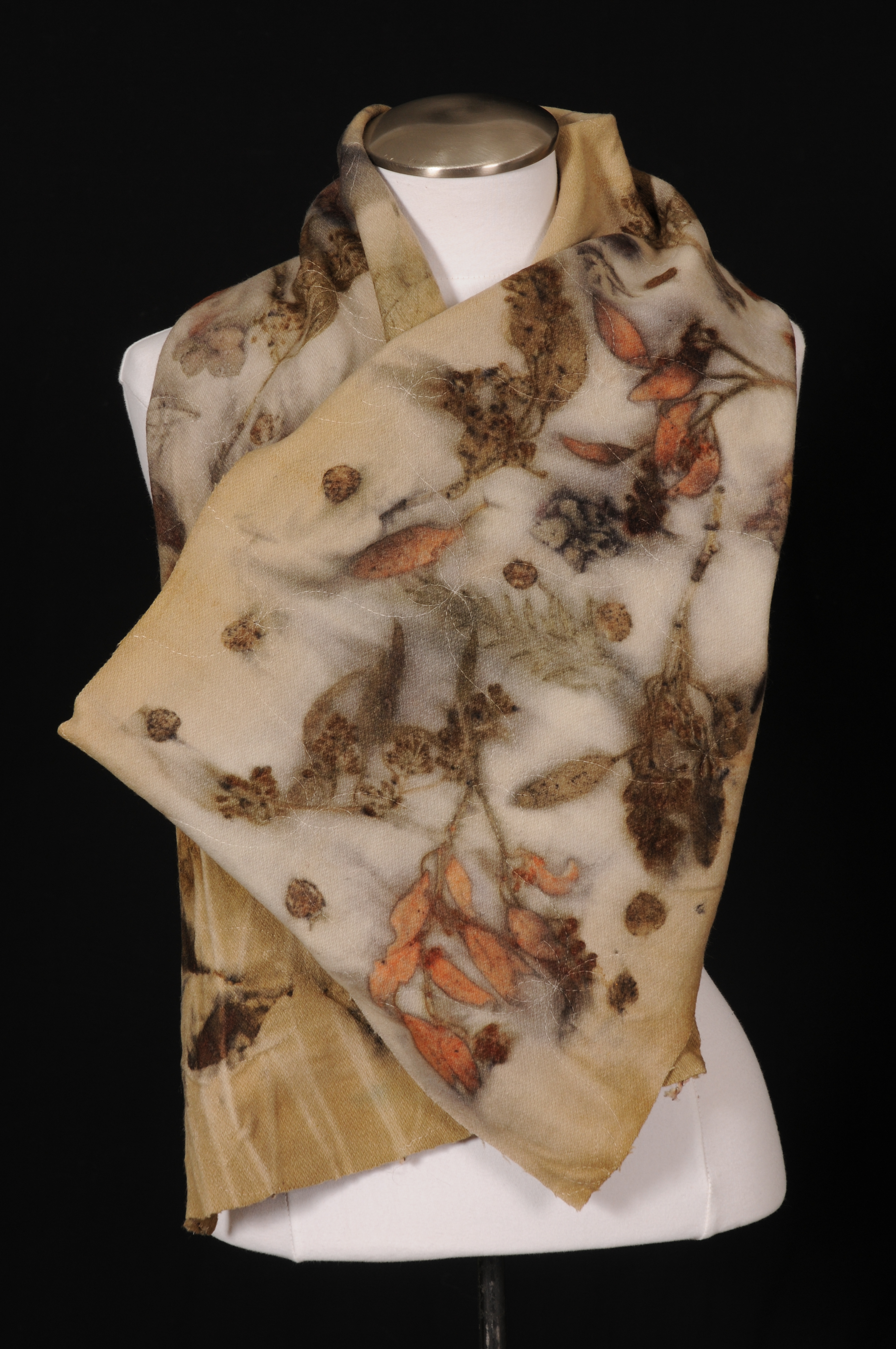
I am by no means a purist as far as attachment to a specific technique goes. Having said that, I love each for their own unique vocabulary. The natural dyes only work on natural fibres and that brings a richness that is unrivalled by anything manmade. I love the smell of the silk and wool in a dye pot of onion skin tied with rose leaves and eucalyptus. The colour palette is soft and deep and reminiscent of an old secret garden hidden away for centuries. I also feel an attachment to the many generations of natural dyers and artists before me when I work in this medium, as if my hands are not the only ones placing and wrapping leaves and flowers against cloth. It’s like a collaboration with the earth and my ancestors.

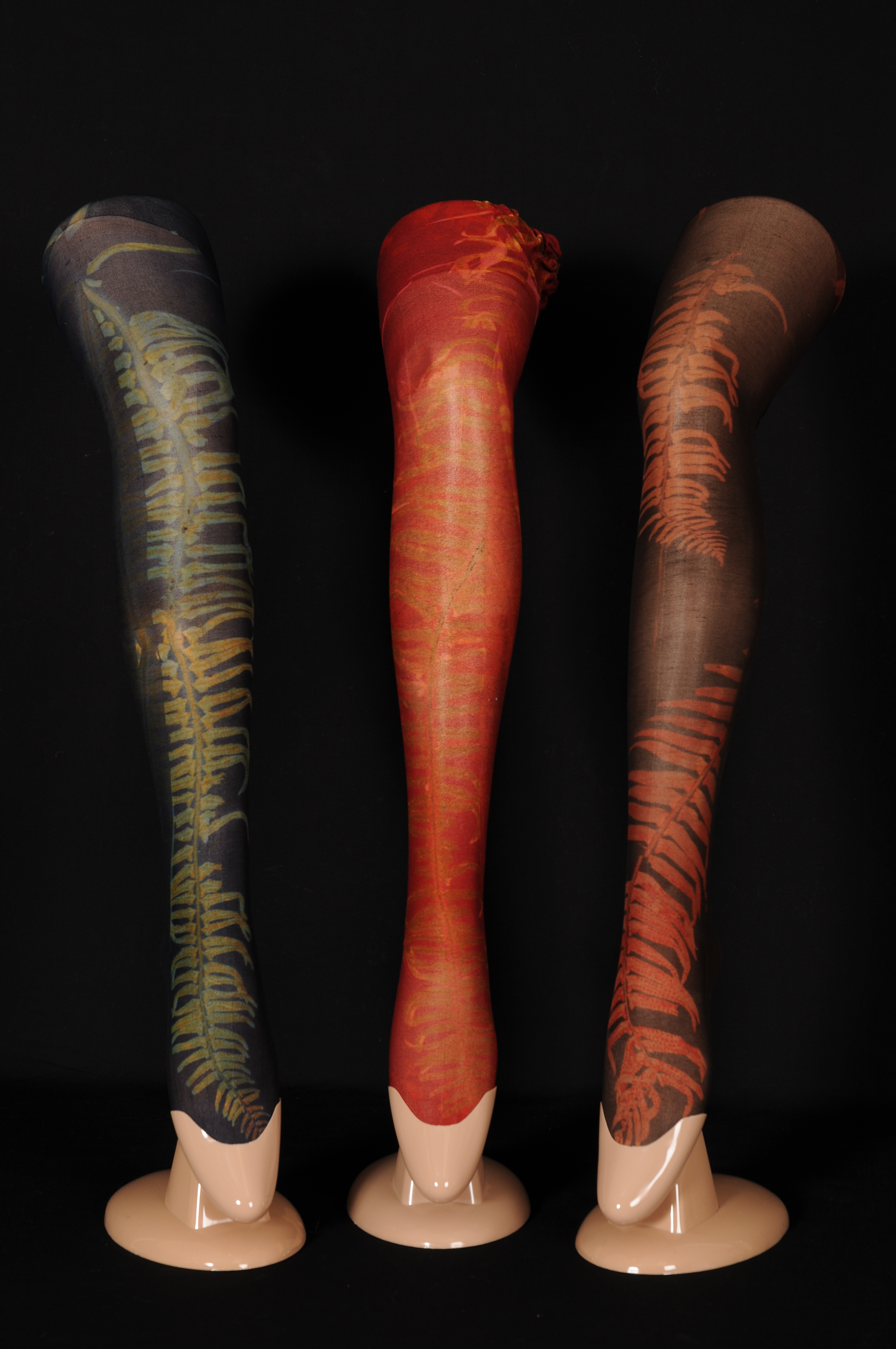
The manmade dyes have a vibrancy and colourfastness not achievable with natural dyes. There is an immediacy in their usage that appeals to my magpie-like attention span. There is also an element of repeatability and reliability that is missing in natural dyes. The dyes that I use on the printed hosiery are polyester-specific and can only be used on manmade fibres. They are particularly successful on hosiery and poly satins, hence the development of the line of printed panty hose and scarves. 

Image

How did your family influence you as an artist?

As a child, I spent a great deal of time with my grandfather. He taught me about the colour wheel using tempura paints mixed by my mother on a wooden easel built by my father. I guess you could say that my artistic side was recognized and supported. I also spent a great deal of time in my grandparent’s antique store which may account for my obsession with textiles. I remember the thick velvets and laces and today, lace images still find their way into my work. My father was an amazing gardener and I think that influenced my colour sense as well as a love for the intricacies of different leaves and flowers. My great grandmother and great aunt lived on Lasquiti Island for many years and collected many books full of pressed flowers which were put into pictures and cards. I was always mesmerized by the delicate petals pressed flat – like I was looking into the secret domain of fairies – or something equally romantic. I still have a picture over my bed made by my great grandmother with pressed ferns and flowers. The aesthetic is quite similar to the imagery on my fern imprinted hose.


Do you have any training or are you self-taught?

I have spent a lifetime exploring textile arts and am a recent graduate of the Caplilano University Textile Arts Program – a wonderful program that was my gift to myself for surviving chemo therapy after breast cancer 5 years ago. This is currently the final term that this 40 year old program will be running – one of the many Arts cuts at Capilano University. It’s such a shame. This program offers students a skill base not found anywhere else.

I was born in Vancouver and have always lived in this area. the West coast imagery is part of my soul. There is never any shortage of inspiration. It can be found on short walk down the road to the river or just out in the backyard. The little fellow that was the model for my raccoon hat was a constant visitor last year. Always by himself, he would come in the evening and hang around in the backyard, watching us with great curiosity. The skunk hat also had a live model although not so cute. He sprayed the dog 4 times last year!


Considering the exaggeration of natural elements in your work, how does living in B.C. affect you? 

Nature has both a fragility and a great strength. It has beauty that is constant and changing. I am always collecting rocks and twigs and leaves whose designs speak to me. My china cabinet is full of skulls collected from under a bald eagles nest. They sit perched on my grandmothers china. Both aesthetics equally precious to me.


Why do you feel drawn to nature?

I don’t know that it was ever a conscious idea or decision. You doodle and draw and paint and slop dye around – Some things appeal and some don’t. I very rarely have something turn out the same as the idea had when I began. Designs morph as you go. I have a very free-flow style of working that follows through the rest of my life as well. Sometimes I think it would be easier to approach things in an organized and structured fashion, but I have come to realize that you can’t fight your brain.


How do you like to use color in your clothing? 

I love colour. It’s all about mood. Sometimes it’s playful with bright colours and other times more subdued and calming. Each day is a new day.


You make both accessories and garments. Which do you prefer, and how are they different?

I probably make more accessories than garments. They are a smaller canvas and I can experiment and work out different ideas. If that experimentation is successful, then it often progresses to a garment.


How long does it take you to complete one piece, usually?

I don’t really work with things one at a time, so it’s hard to say. If I am doing hats, I’m washing fleece and as it dries I am carding other fleece and felting blanks. While they are drying on hat blocks I am needle-felting the features on other ones. It’s like an assembly line – a skill I developed through years of hairdressing. The panty hose are the same kind of thing. I am painting the designs on paper, while its drying I am collecting and preparing the ferns and leaves, then laying them out in stacks and heat setting them. I do tend to do things in runs. If I am making scarves then its a scarf day or a felting day or a flower day, mostly because each thing requires a different set of equipment and I have a small space to work in.


When you are picking which objects to incorporate into the cloths, what do you look for? 

Sometimes on a walk I will discover plants with interesting shapes or in the thrift store i’ll come across some really tacky doily with a lot of texture that is perfect. I feel like mostly, the things find me. Like the other day, I took the dog to the off-leash dog park and he shot off after a duck with me chasing after him. During that little adventure, I discovered the ferns that were growing from the trees – slightly softer and smaller than the ones I had been using. I was curious to see if they would work and how they would translate on to cloth. I loved them so I plan to go back later this week and pick some more.I am always careful to pick gently and not take too much, especially with things like lichens.

Image

Explain the process of making those objects a part of the fabric. Is it difficult?

Sometimes I will paint the actual leaves, others I will make silk screens of the leaf images and screen the dye on. Sometimes I draw the images by hand, or a combination of all 3. It’s not any more difficult than another technique but it does require a fairly in-depth understanding of how the dye works and some specialized equipment.


How did you learn to do it?

I learned my basic skills at the Textile Arts Program at Cap U and have actually just completed a directed study to develop this technique. I wanted to take advantage of the last term the program is running to further my experimentation.


Where do you find your materials?

With the leaf imprinting, any time I leave the house I usually find something. My pockets are always full of leaves and twigs and seeds. The hats I buy use local specialty fleeces and  I process them myself. The fabrics are often rescued or vintage.


Do you ever work with others professionally, or do you prefer to work alone? 

I love collaborations and I love creating in solitude. Sometimes it’s nice to have someone of a similar mindset around to assure you that you are not crazy and to bounce ideas off of.


What is your favorite piece to make?

Every piece I make is my favourite piece in that moment. Although I have to say I am really enjoying the panty hose currently.


Which fabrics do you use for each garment? How do you treat each one differently?

Each fibre and fabric type – wool, cellulose, and polyesters – all require different dyes and treatments. I use wools for hats, scarves and shawls which may also incorporate pieces of silks or polyester.


How do you experiment?

Everything I make is an experiment. I am a messy artist, not by intention. It’s just that when I am working, I am oblivious to the rest of the universe. 


How do you get such original ideas? Do you have any ways to encourage yourself creatively?

I think it is important to spend time with other creative types to keep the energy up. It’s also important to give myself time to create; turning off the phone and working undisturbed even if its just to mix dyes and sweep the floor or unroll fabric. I try to do my initial experiments without attachment to the outcome. I fine tune an idea before committing it to a 500 dollar piece of cloth. Sometimes doing something in a completely foreign medium is a great creative boost.


Do you have any other jobs or hobbies?

I foster high risk youth in the other part of my life. I like to garden and I like to cook.


How does your personal life affect your professional life?

I think the high stress level from my job fuels the need for creative expression. They kind of feed off of each other. Over the last 2 decades I have managed to keep a fairly symbiotic relationship between the 2 sides of my life.


What are you hoping for at this year’s Art World Expo?

I am really looking forward to this expo and am excited to be involved in such a creative venture. I am hoping that my textiles will be well received and I look forward to making many creative contacts. Did I mention that I was excited?


Claire Brooksbank coming from Portland, Oregon for AWE 2014 Body Painting Competition!

Interview With . . .

Claire Brooksbank

by Alyssa Laube


About: Meet Claire and Damien Brooksbank – one of Portland’s most talented duos. This married couple is anything but ordinary, specializing in makeup, costumes, and special effects. They own and operate DSD FX Studios, and are the recipients of many prestigious awards for their work. For more information, please visit DSD FX Studios on Facebook: https://www.facebook.com/pages/DSD-FX-Studios/128132451267 


claire1 claire7claire4


What is it like working together as a married couple? 

My husband and I have always worked together, from day 1. Without each other, neither of us would have gotten into makeup artistry at all, let alone body painting and special effects. Nowadays, I do actually work more on my own than as part of a couple, but I definitely prefer it when my husband is working with me on a project. While there are definitely challenges working professionally with someone with whom you spend the rest of your private life, I find that having my husband with me works as a means of balance – when I’m stressed out and unable to work myself out of a jam, he’s there with a solution and keeps me calm, and vice versa. That’s not to say I’m incapable of troubleshooting on my own, but it’s definitely easier with him around. It also means that we can continue brainstorming and creating in our private time, as well – we are constantly discussing projects, no matter what time of day or where we are.


You are involved in such a variety of practices, how do you keep your skills sharp for all of them at the same time? 

All of the skills we use tie into the others or apply to all of the fields we work in. I use airbrush techniques in everything – body painting, special effects makeup, beauty makeup, prop making, costuming, and even painting on a canvas. I use brush techniques in the same way. The anatomy skills we use are useful in all of them. Also, because we hybridize genres so often, we’re frequently using skills and techniques from one genre in another (for example, combining high fashion beauty makeup with prosthetics or body painting). The fact that we’re always creating something, whether for a client or on personal projects, keeps us on top of everything and constantly improving. As a matter of fact, my airbrushing skill really improved while working on set painting at a haunted house.


Do you each consider yourself to have your own specialty? 

Absolutely. We’re each competent in everything we do, but we definitely have our own personal areas of excellence. My husband is a much stronger sculptor and fabricator than I am, and he’s the first to tell everyone that I’m the stronger painter and airbrush artist. The fact that we each specialize in different areas means that as a team, we’re so much stronger and can rely on each other on a project instead of trying to take it all on ourselves. Recently, while working on a prosthetic makeup for a friend of ours, I was doing the sculpture portion of work and got frustrated in the detailing process. Instead of getting totally fed up and not enjoying working on the project any more, I was able to hand it off to my husband to work on while I moved on to other aspects of the project.  Not too many people in our field have that opportunity.


The use of collaboration seems to be greatly important to DSD FX Studios. Can you describe this relationship and why it is important to you? 

Collaboration is vitally important to us. The artistic community will never grow or be stable so long as we’re all off doing our own thing and not interacting with each other. By collaborating with other artists, we network and foster friendships, which strengthens the community by creating a positive bond instead of focusing on competing with each other. One would think that maintaining that kind of competitive nature would mean that we would be able to snag more work for ourselves, but in fact, the opposite is true. We started getting more work when we started really trying to be friendly with others in our field. Also, when we collaborate on a project with someone, the attention received benefits us all. We believe that “a rising tide raises all.”


You’ve won a number of awards. How does it feel to have your  name be so big in the business, and did you ever expect to win them? 

It’s indescribable. The recognition is just amazing. It’s also totally surreal. When we won both our awards, I truly thought we didn’t have a shot. For the Portland Fashion and Style Awards, I actually didn’t attend the event because I was so totally convinced it would go to someone else. I was actually out doing makeups for Halloween parties that evening, and found out long after the fact that I’d won (I had sent a friend of mine in my place, but just figured she’d be a place holder). With RAW, we decided that no matter what, we were going to go in and have a blast and make cool things for the hell of it. We figured it would go to a “straight” makeup artist instead. The fact that we’re winning things tells me we’re heading in the right direction.


How has the makeup/effects industry advanced since you started working in it?

The makeup and effects industries are constantly shifting and changing. New techniques and materials are popping up every time you turn around. To be fair, though, we started out late and somewhat in a bubble, so we did turn onto certain things later than some. We’ve seen the development of transfer appliances (a 3D piece on water slide paper that applies like a temporary tattoo), though, which has been a game-changer. There are beauty makeups now with a silicone base, whereas before the options ran to water and alcohol solutions. It means we have to be constantly on top of new methods so that we stay current. There have been notable changes in the industry as a whole, but not necessarily advancement. In fact, the industry is much more difficult to stay afloat in, with so many productions turning to CG as a cheaper option to special effects and the easy availability of digital cameras making it possible for virtually anyone to make a movie – a lot of productions work on ultra-low or no budget. In addition, shows like Face Off, while simultaneously boosting a return of popularity to practical special effects, are resulting in an over-saturation of aspiring makeup artists which makes it even harder to compete and still be financially solvent.


How have you, collectively and individually, improved over time? 

Well, one always improves as one repetitively uses skills. Obviously, when we started out, our work was incredibly rough in all areas, from prosthetic appliances to body paint to specific skills like airbrushing. Over the years, we’ve worked out the kinks, and there’s much more finesse in the work. I suppose the best way to answer this is to say that we learned from copious mistakes and continue to use mistakes as a learning opportunity instead of treating them as failures. We also seek out all possible educational opportunities, such as classes from other artists, tutorials, and books. In addition, we use collaborative experiences and trade shoots as an opportunity to try out something new or to hone a particular skill and seek to find ways to apply current skill sets to other areas – I actually personally bloomed as an airbrush artist while painting walls at a haunted house. While I was painting fake cracks and holes  on a “stone” wall with the airbrush, the light bulb switched on and I suddenly had the feel for how to get incredible detail with the airbrush, where before I might have leaned on a use of a fine detail paintbrush instead. We use 3D sculpting techniques in everything – you can take the idea of shaping clay with a tool to carving foam, or moving around acrylic gel on a canvas. I use prosthetic blending techniques to make multimedia recycled art pieces (like my Monster Boots – I attached a bazillion fake eyes to them and blended them down to the boot to make them look alive).


There has been a great deal of censorship on the work of body painters. How do you feel about this, and what actions to you think should be taken in response to it?

Most of the censorship taking place in regards to body painting is on social media networks. Virtually every social networking site has some sort of terms of use/content guidelines in place to protect its users from being exposed to objectionable content, and with certain sites having a demographic under the age of consent, obviously having those safeguards in place is useful. However, each individual person’s definition of what constitutes “objectionable content” is highly, highly subjective, and frequently the standards are not evenly enforced. Preference seems to be given to the moral minority (believe me – the number of people one finds that find body paint offensive are actually extremely low) and sites pander to the lowest common denominator, thereby impacting a large number of people who use social networking to a) engage in business promotion and showcase their work in a way that’s accessible to a large number of people and b) seek out and view specific topics such as body painting. Social networking is an amazing way for artists, photographers, models, and fans to connect, and it’s such a shame that persecution and censorship is allowed to prevail.

Most often, body paint work gets lumped in with sexually suggestive or downright pornographic content, between which any rational human being with eyeballs for the most part can easily distinguish. Now, one would think this means that no hardcore pornography would exist on these sites, but that’s just simply not true. I haven’t done any experiments on other sites, like Google+, but I know that on Facebook alone that the search term “XXX” brings up pages upon pages of hardcore pornography. Meanwhile, countless body painters, photographers of body paint, and body paint models are having their images flagged, removed, and in many cases, having their user accounts banned from using the site for spans of time from 24 hours to months. Also, friends of mine have done experiments on the enforcement of standards by seeking out pornography and reporting it, and in many cases, the images are not removed. Also, more commercial applications of body paint (such as in advertising for national brands) are allowed to remain. What’s unsettling and frustrating is that much more sexually evocative images are allowed to remain in full view of everyone – modern pinup girl images frequently involve much more nudity than the average body painting, if one takes into account the revealing nature of most lingerie, and the tone of the images is far and beyond more sexually suggestive than virtually any body paint photo I have ever come across (obviously, there are exceptions to every rule).

In response to this, some of us have taken action in a variety of ways – some have started and circulated petitions to ask that the websites evenly uphold standards and either enforce them across the board, or to stop removing body paint images and to stop banning body painters’, photographers, and models accounts. Others have simply begun to boycott the offending sites, moving their work to platforms that are more tolerant, such as Tumblr. Still others have become vocal about the issue and have taken it to media outlets, gaining public attention, at least on a local level. I am one of the latter type – when my friend and mentor, Matt Huntley, had images removed and was banned for 30 days, I started raising hell. I wrote to every news outlet I could think of, and started up a Facebook page – www.facebook.com/bodypaintersunited – in protest of Facebook’s handling of the situation.

I could go on and on about what I think needs to change in order to fully stop the issue of censorship, but I think some of that may be a topic for another time (things like completely changing the sexual landscape of society, from one of repression and abstinence to a more open-minded approach and whatnot).


Is there a difference between working with theatre and film? 

There is a huge difference between working a theatrical production versus a film. In a theatrical production, one’s work must carry to the back of the house in a low-light situation, and leans to an extremely cartoonish appearance when viewed up close. In film, you’re generally working in an extremely close-up format, and work must be much more subtle to play well. In addition, film is starting to trend towards HD filming which brings in a whole new set of problems for not just special effects artists, but cosmetic makeup artists as well. Foundations much be much softer and lighter. Blending has to be spot on. Theatre can be really, really forgiving – no one is really going to be right up close on the actor while they’re giving their performance, so minor flaws disappear to the audience. Film is not so much. There’s actually a great anecdote about prosthetic makeups in Peter Jackson’s The Hobbit films – the prosthetics used on the dwarves actually have a Pepto-Bismol pink base tone due to lighting challenges in combination with the particular type of HD cameras they were using to film. The special effects department head found that without that pink base, there was an obvious transition between living tissue and the silicone rubber appliances on screen – living tissue has a pink tone to it because of blood flow. He quickly adapted to the situation and found a way to fake that blood tone in the appliances which lead to the much more believable makeups you saw on screen.


What is your favourite type of makeup?

I really, ridiculously enjoy creature makeups – making some fantastical being come to life is just amazing. I mean, gore and trauma can be really fun. Who doesn’t like playing with fake blood? But there’s just something special about creating a creature and seeing it in front of you. I love all makeup. I wouldn’t do it if I didn’t. But I’m definitely happiest when turning someone into a something fantastical, whether it’s face paint, body paint, prosthetics… it doesn’t matter.


How did you receive your training? 

I’m 100% self-taught. I’m an experimenter. It started when I was a kid, playing with my mom’s makeup, continued into teens (that’s when I learned how to block out my eyebrows), and on until today. I didn’t even know there were schools you could go to for makeup artistry until just a few years ago, and by then, I was already knee-deep in this stuff. I learn best by trying something and tweaking the process until it makes sense to me and I get a good result. I’m also a voracious reader, and I devour Makeup Artist Magazine every time it comes out. I collect text books on theatrical and effects makeup. The pride and joy of our collection is a trilogy of Japanese Special Effects books – we found the first one in 2009, and the rest is history. We learned a lot from them. We also subscribe to the Stan Winston School channel and buy their videos whenever we can. I have great relationships with a number of makeup artists, body painters, and special effects makeup artists, and I’m totally unafraid to ask questions.


What is the most challenging work you’ve done? 

Every piece I do has its own unique challenges, each unlike the next. More often than not, the biggest challenge is beating the clock. You often don’t get as much time as you’d like to get a makeup done for film, theatre, or photo shoots which can lead to rushing and little mistakes that stick out like a sore thumb to you after you’re done. Otherwise, I have run into personality conflicts, lack of communication… all kinds of hiccups that can make the job more stressful than it needs to be.

I think the most challenging makeups we have done were for the Portland RAW Artists semi-finals, though. It was a pretty ambitious project – we took four models, made costume pieces for them, and applied the makeup for the runway show. We couldn’t have done it without our two extra hands – Cody Shaw and Matt Huntley.


A lot of your work with costumes is very unique and fantastical. What is the strangest piece you can remember working on?

I really can’t think of anything that truly qualifies as “strange” to me. I deal in the fantastical, so nothing is really too weird in the moment or after. All of the costume work is like a big puzzle to me- it’s just a matter of putting all the pieces together in the correct order.

My favourite, though, was a costume we made for a haunt actor in Salem, Oregon. He commissioned it from us based off Diesel punk ideas. It was also probably one of the hardest costumes we’ve made, too, because it had several LED features, and figuring out how to wire them and disguise the switches was uniquely challenging. It came out really well, though, and he was a very satisfied customer. We got to see it in action that season.


Considering you work with films, are there any movies or directors that have greatly influenced you? 

I am absolutely influenced by the works of Clive Barker. His aesthetic and thematic components just click in my brain. Nightbreed is just gorgeous – probably some of my favourite monster makeups in existence. I’m also a huge fan of Tim Burton’s work.  Jim Henson’s creatures have also been a huge inspiration since childhood, along with films like LegendThe Addams’ Family, and The Never-ending Story. I’m also heavily influenced by fine artists, comic books, video games, and books (yeah, I know that’s a weird one).


Has the rising popularity of zombies brought any business for DSD FX studios? 

I. Am. So. Sick. Of. Zombies. Enough already!

But in all actuality, yes, zombies have been pretty lucrative over the years. One of our first big solo gigs was doing makeup for a zombie opera. Since then, haunted attractions, Halloween makeups, and Zombie 5K’s have all brought zombies even further into our lives.

What do you hope to explore in the future? 

I hope to one day have the opportunity to work on a big-budget feature film, either contracted independently or as a part of an FX shop. I also am working towards competition on a more regular basis in body painting, culminating in attending and competing at the World Body Paint Festival in Austria. Until then, I will keep poking around!


Waffle Gone Wild at Art World Expo!

We are very excited to have our first ever Food Lounge at Art World Expo this year! Debuting as our first restaurant partner, we welcome Waffle Gone Wild to our show!

Little Monsters at Art World Expo!

Interview with…

Little Monsters Studio 

by Monika Blichar 


Meet Artist Kathleen Erickson from Little Monsters Studio! 

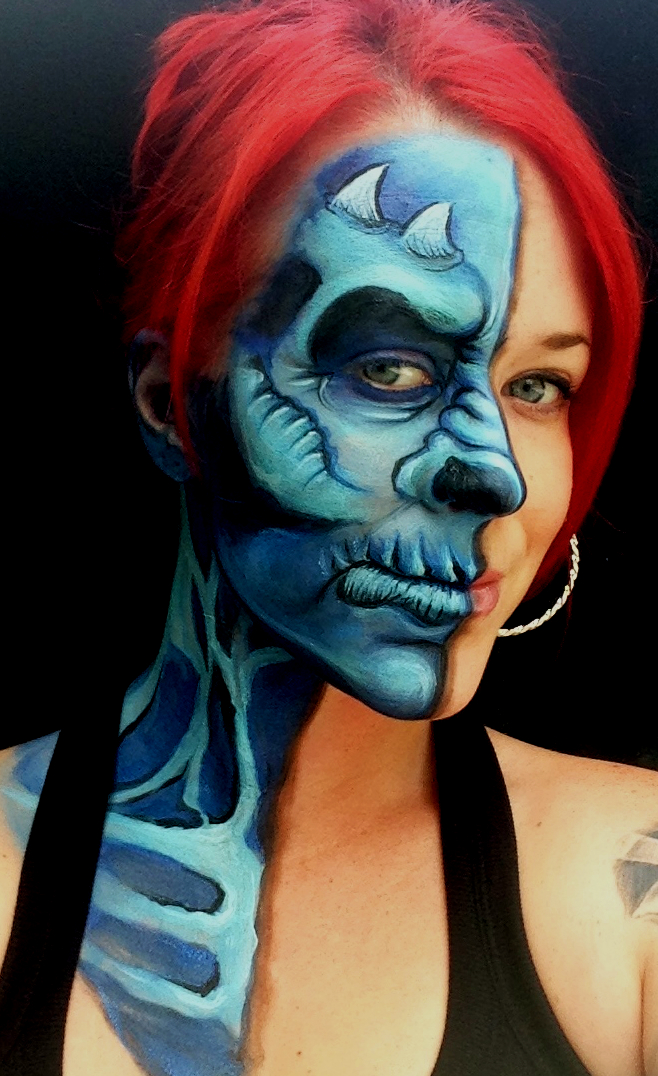
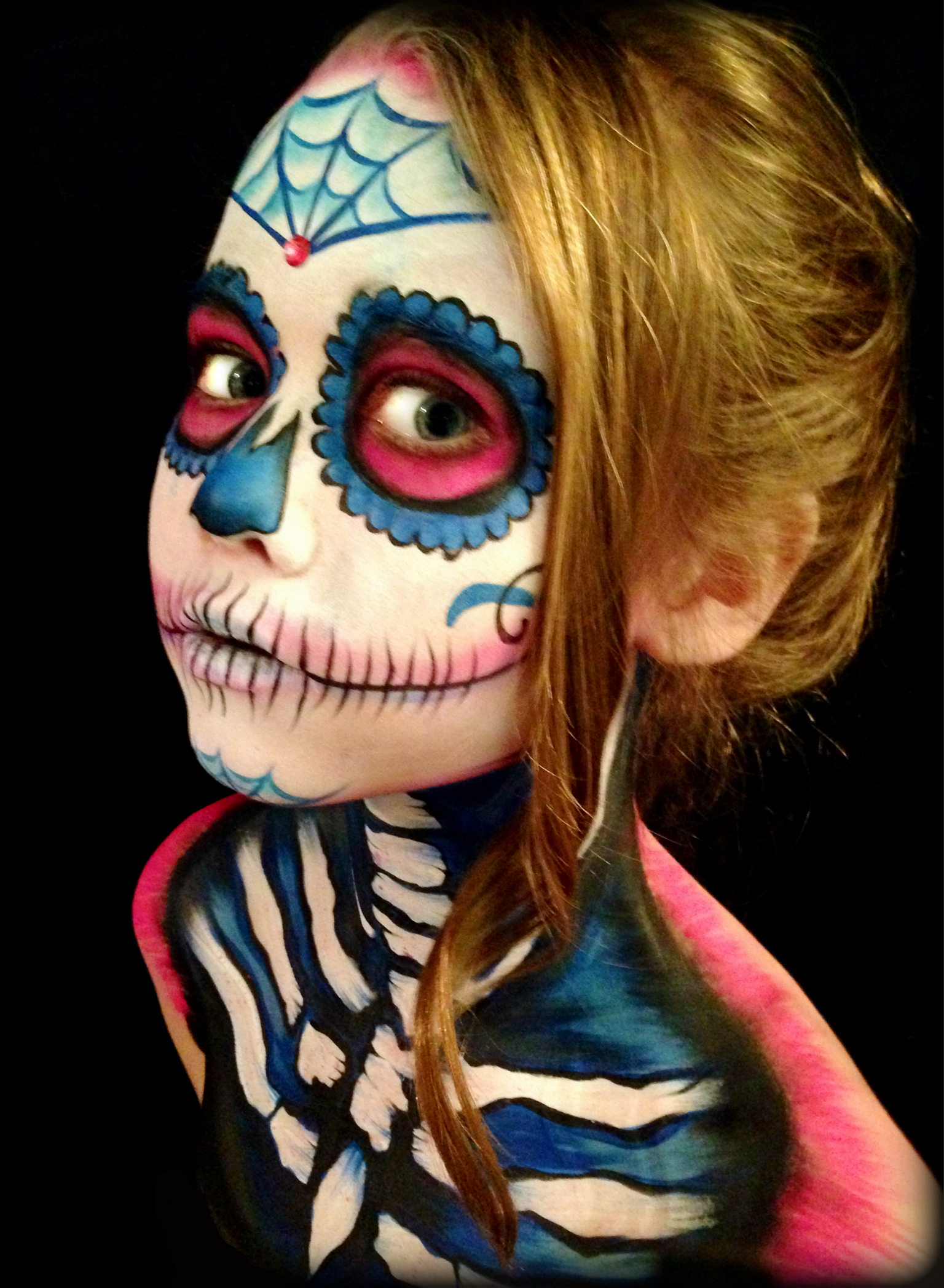
A first time competitor, we are very excited to see what this Monster can do! Apart from having amazingly talented creative skills in face and body painting, Kat is also an accomplished visual artist creating unique pieces like custom paintings and growth charts for kids. We caught up with Kat and asked her a few questions about her experience as an artist in B.C. Here is what she had to say! 


Image

When did you start doing face/body painting?

I took a more serious approach to my painting when I turned 15 and being an artist; I was always experimenting creatively with my children and painting their faces. This helped me transition into starting Little Monsters Studio three years ago.

 Image

Your family and work seem to blend together. How have your kids helped you with your inspiration for your business?

I find with maturity, I sometimes start to take a more scientific approach to my art. So having children helps to keep my art especially my body art & face painting fresh & unconventional.

My children & their friends always want their faces painted and it makes for great family outings like going to the Vancouver Zombie Walk or getting painted for a Seahawks game with my husband.


This is the first time you are competing in Art World Expo body painting competition. What are you looking forward to the most as a first time competitor?

The competitive nature of any competition will only help me to improve in my craft and with my confidence. But what I’m really looking forward to is being surrounded by so many exceptional artists and talented people.  Just being part of this contagious atmosphere and networking with my peers, will be stimulating enough. Then there’s all the great art.


What kinds of services and merchandise do you offer the public?

Face painting & body art are my primary sources of income, but I also sell my paintings and growth charts. During the month of October, I open up my studio to work on big Halloween projects for costume competitions and parties.


What is your biggest dream regarding your art and business?

My goal is to be able to support my self enough, so I am able to continue to focus on projects that I love. I adore body art and especially the Halloween spirit and just being able to continue to grow in this realm would be ideal.


Image

Welcome to the show Kat! Wishing you good luck! 


For more information about Little Monsters Studio, please visit Kat and her troop on her Facebook site: https://www.facebook.com/littlemonstersstudio?ref=br_tf


Art World Expo & 360 Replays

ART WORLD EXPO TM is pleased to present this amazing video of a one of a kind body art installation featuring the creative process in a unique way captured by 360 Replays.

360 Replays develops interactive technology for Internet TV. Their mission is to make interactive TV the regular TV on the planet. In addition, 360 produces camera systems that can be used to capture interactive content delivered over Internet television.

For more information about 360, visit:
https://www.360replays.com
https://www.facebook.com/360Replays

Art World Expo is an annual large scale art show and fundraiser featuring over 100 artist exhibitors, fashion shows, a body painting competition and live demonstrations. The fourth annual event will take place on May 2, 2014. The event is produced by MAB Ventures Inc., An Arts & Entertainment Agency with proceeds benefiting Make and Break Arts Foundation. The event takes place at Telus World of Science in Vancouver,BC, Canada and features artists from around the world.

For more information about the event or to purchase tickets, please visit:
https://artworldexpo.wordpress.com/

https://www.facebook.com/ArtWorldExpo?ref=br_tf

Order tickets by phone 604 999 6177

Body Painting Artist: Cory Keys

Hair & Face Make Up: Monika Blichar
http://www.monikablichar.com

Model: Emily Blackwell, Red Goddess Talent
http://www.redgoddesstalent.com/
https://www.facebook.com/pages/Emily-Blackwells-Fan-Page/187599184648341

Thank you to the Art World Expo TM 2014 Platinum Sponsors:

Twin Peaks Construction
http://www.twinpeaksconstruction.com

Fresh Vancouver Magazine
http://www.freshvancouver.com

Creativity Needs to Be Constantly Nurtured-An Interview with Rod Preston

Interview With…

Rod Preston

By: Alyssa Laube

About: Rod Preston is a talented Vancouver-based fine art and portrait photographer. His work can be viewed at:

http://rodpreston.ca

rodpreston

rodpreston-mystiqueboutique

What is it about Vancouver specifically that inspires you as a photographer?

Clouds, crows, trees, reflections in puddles and 300 days a year of beautiful soft light.

How does editing play a role in your work?

Photoshop is such an amazing piece of software that has opened up so many creative alternatives for me as an artist. However, I try to use it sparingly in my fine art photography. I like to remove distracting objects, crop, mute colours, and increase contrast. Other than that, I want a mostly realistic look.

When choosing whether or not to keep a photo, what do you look for?

First, proper exposure. I like to see detail in the highlight and shadow portions of the photo. After that, it becomes much more subjective. I like stark images that convey a feeling of loneliness or neglect.

How do you pick subjects for your photography?

I try not to have too much of an agenda. I’ll just shoot whatever interests me in that moment, but I’ve noticed that people are conspicuously absent from my recent work. It’s a phase, but I’ve done lots of portrait work in the past, and I’m sure I will again.

What are the differences between photographing a person and a scene?

There’s a huge difference. With people, it helps to photograph someone I know so that I can choose images from the shoot that reflect their manner and personality. There’s often pressure during a portrait shoot to meet the subject, get a sense of their character, set up the shot, and produce a great image very quickly – which is not easy. By contrast, “landscape” photography is much more methodical and solitary for me. I have lots of time to really take in my surroundings and experiment with all kinds of ideas. I enjoy both, but they are very different skills.

Describe your work with publications.

In 2008, I was commissioned to create a portrait series for a book about addiction by Dr. Gabor Mate: “In the Realm of Hungry Ghosts: Close Encounters with Addiction”. It’s a bestselling book about a topic that has relevance to all of our lives. I encourage everyone to check it out. I have worked in Vancouver’s Downtown Eastside since 2000, so I knew many of the subjects of my portraits quite well. I’ve also done lots of assignment work for The Medical Post when they have featured Vancouver-based doctors in their articles.

What are your favourite things to photograph?

I’m often drawn to subjects that illustrate the interaction between humans and our natural environment – the eternal cycle of destruction and reclamation shown in rusting ships, abandoned spaces, and fabricated objects that represent living things. I also like to take everyday objects and make them look slightly surreal. I’m always happy when a viewer of one of my photos asks “What is this?” or “Where was this taken?”.

How did you get started in photography?

When I was in grade 4 or 5, I was in an advanced class called “Enrichment” for a few hours a week. We did all kinds of cool, alternative things in these classes and photography was one of them. Then, I didn’t touch a camera for about 10 years. When I was 20, I took a semester off university to drive across Canada and back. I took a simple point-and-shoot camera with me and really started to enjoy the process. After getting my degree, I immediately started to study photography at Langara College.

What is your favorite camera to use?

My Nikon D700, and I have an old Ricoh GR1 for shooting film that fits nicely into my pocket if I don’t want to lug lots of gear.

How does the use of lens change the photo?

Focal length is probably the biggest factor. A wide angle lens includes much more in the frame than a zoom. Faster lenses are great for low light situations, creating a very nice background blur.

Do you have any favorite local photographers?

Robin O’Neill, a Whistler photographer.

Who is your favourite photographer, in general?

It’s a toss up between Ansel Adams and Ed Burtynsky.

What inspires you?

I’ve recently been looking at some 365 projects that other photographers have done. That involves producing an image every day for a year as part of a series. I’m inspired by that dedication, discipline and creativity. I plan to do it myself (maybe in 2015).

Has your family had an effect on your work?

My mom, dad and sister have all been very supportive and I really love showing them my work and hearing their feedback.

What do you love about B.C. as a whole, in terms of how good of an environment it is for photography?

For a guy who grew up in Manitoba and Saskatchewan, I have to love the diversity of landscapes that we have in BC. I could travel for the next 10 years in BC and never see the same thing twice! We are truly lucky to call this place our home.

How do you manipulate the use of colour in your work?

I like to mute colours a bit for a hint of “surreal”, but more than that is too much for me. The colour treatments in the movies “Saving Private Ryan” or “Three Kings” are good examples of what I’m talking about, but overall, not much.

Explain how weather influences what you do.

I love cloudy days, and that is the biggest determining factor in my decision to go out and shoot. I like even, light and saturated colours.

Have you spent much time photographing other places? What was it like?

That’s a big question. Yes, I’ve travelled the world: Southeast Asia, Canada, the U.S., Central and South America and the U.K. It’s such a pleasure for me to feast my eyes and camera on things I’ve never seen before. I’ve had many long days of hiking around with my camera in faraway places. It doesn’t get much better than that!

How do you try to improve your photography?

Creativity is something that needs to be constantly nurtured. I have a notebook where I write down ideas and take notes, but the best way to improve is by doing.

Which is a favourite photo in your own collection?

Hard to pick just one, but I really like an image that I took just off the highway between Merritt and Kelowna. I drove up a logging road and found a seed block in the middle of a clear cut. A group of skinny trees standing all by themselves gives such an eerie feeling. I titled it “The Last Stand”.

Which settings do you prefer to use?

Aperture Priority. I choose the aperture so I control the depth of field (i.e. how much of the scene is in focus) while the camera automatically chooses the shutter speed to give proper exposure.

What advice can you offer to budding photographers?

Set achievable goals for yourself. Plan one photo project per week. It doesn’t sound like much, but if you stick to it, your skills will improve considerably.