Author: monikablichar

Monika Anna Blichar was born in Latina, Italy in July, 1982. After immigrating to Canada in the early 1980’s, the family lived in Red Deer, where they bore a second daughter, and then moved west to B.C. in 1996. Monika has completed a B.A. in English and French from the University of Victoria and has also obtained a teaching credential with the B.C. College of Teachers. Primarily self taught, she has also studied art at Camosun College where she learnt various techniques and strategies in creating contemporary pieces. She continues to pursue creative projects and is exploring various professional opportunities in the arts which include body painting and events coordination. Her interests include the Humanities, writing, traveling, and being outdoors. Art has played a significant part of Monika’s life and continues to be an expression of her flowing imagination, appreciation for beauty, and a reflection of seeing beyond the obvious. Monika is currently living and working in Vancouver, B.C. She is the owner of MAB Ventures Inc., An Arts & Entertainment Agency, and is President of Make and Break Arts Foundation. Her notable projects and initiatives include founding Art World Expo, Diamond Dolls Women's Networking Group, MAB Arts Studio & Boutique Gallery and THE FAB Art Program.

Carve or Starve!-An Interview with Jesse Toso

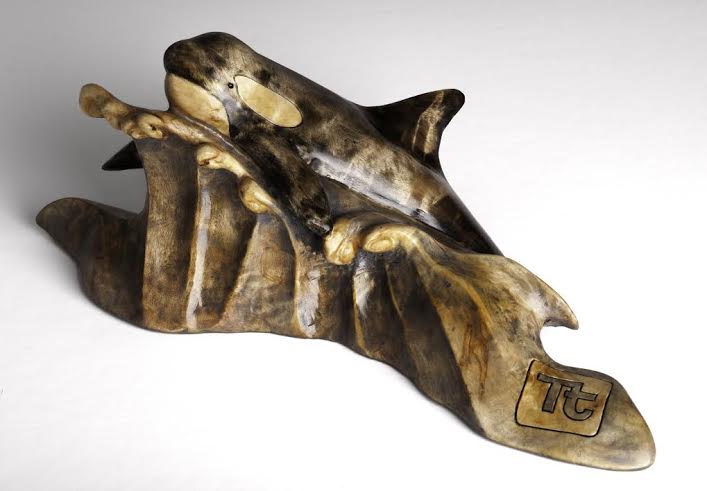
About: Jesse Toso, born and raised here in British Columbia, is a talented woodcarver whose tool of choice is equally impressive: a chainsaw! To see some of Jesse’s extraordinary work, go to: 
http://www.stumpartist.com

Image

Image


The first time you carved was at a competition in 2005, at which you took first prize in the Amateur category! What motivated you to take part in the competition, and did you have a feeling that you would be a natural?

I grew up in Campbell River where the Transformations on the Shore Chainsaw Carving Competition has been taking place since 1997 and I remember looking at the amazing carvings produced at the event each year and I thought to myself: “I could do that”.  So,  I borrowed a chainsaw and hacked away at this giant piece of Douglas fir and by the end of the week, I had shaped out a Phoenix. After taking home the $1000 prize, I decided to do it every year after. This year will be my tenth!


Why do you prefer to work with a chainsaw, rather than other tools? 

Chainsaws are fast.  

In your opinion, how does the type of wood influence the final carving? 

The type of wood I use influences the final carving immensely.  The colour, the size/shape, the grain are all contributing factors.  Sometimes I look at a piece of wood and determine what to carve based on it’s shape and type, and other times I will want to carve something and look for a piece of wood that will work, but ultimately it is the wood’s inherent qualities and characteristics which influences the final carving.

What did you do for a living before wood carving entered your life? Do you think you will continue to wood carve for the rest of your career? 

I am a carpenter by trade as is my dad so working with wood comes to me naturally.  I will continue to keep carving wood, but I am also interested in exploring the artistic relationship(s) between other building materials, namely: glass, metal and concrete.  And I’ve always wanted to try carving ice.

What is the best part of working in wood carving?

Wood is a beautiful, natural, and quite versatile.  And it’s sustainable.

How have you improved over the years? 

I improve every time I carve. Going to annual carving events such as the competition in Campbell River and Carva-Palooza (an annual chainsaw carver’s convention in Ontario) has also been a huge boost.  I hope to continue improving with every carve.

What do you consider your most difficult piece? How about your favorite one? 

I would say the 16-foot spider hanging on the side of a building in downtown Campbell River was my most challenging and my favourite, too.  It involved creative engineering, 3D visualization, chainsaw joinery, and it was done in five days (as a part of the carving competition).  Also, it caused a bit of controversy.  People wrote into the local newspaper asking it be taken down as they have arachnophobia and could no longer go to the theatre because of the giant wood spider overhead!  Other people then responded in defence of the spider, and it so had people talking in Campbell River.  Which is what art should do, right? I have since carved several spiders and I will be bringing a “smaller” 8-foot version to Art World Expo.

You’ve worked on a variety of different sculptures, mainly focusing on animals. Do you prefer to use nature for your inspiration and how come? 

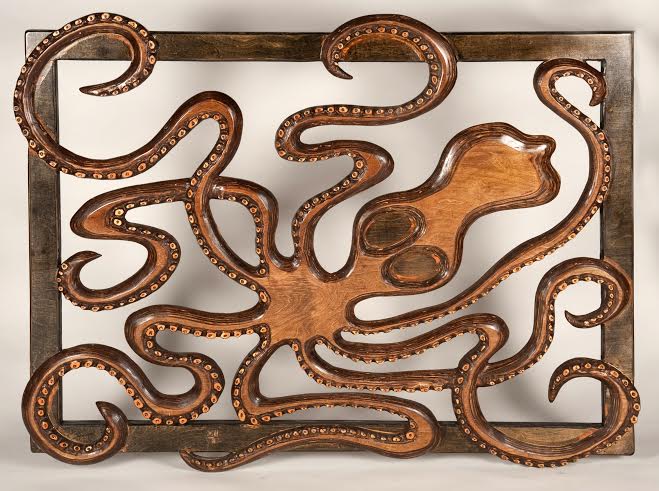
I am drawn to curvy, smooth, rounded, flowing shapes such as octopus legs, dragons, or the neck of a heron, and so find myself carving such shapes.  It happens that most things with these characteristics are from nature.

How has working first-hand with nature changed your relationship with it? 

Trees are precious. I am honored and humbled when I carve into wood that had once been a tree that had been standing for hundreds of years. I feel I need to use every bit of the wood I am carving.  Many of my carvings are from off-cuts from other carvings. 

Do you think that wood carving differs from other forms of art? How so? 

All art is expression. Carving wood with chainsaws is just another way for me to say: “Look what I can do!”

Do you have any advice for beginners in the field? 

Carve or starve! 
 Image

Have you ever done a collaborative piece? If not, would you like to? 

I have done several collaborative pieces.  As a part of Carva-Palooza, one of the several carvings we do is made with a partner. Actually, this year I will be leading a group project (at Carva-Palooza) where eight of us will carve a complete chess set out of logs. I am really excited to see how this turns out.

Emotional Narratives with Kinetic Energy-Eric Goldstein

Artist Statement-Eric Goldstein

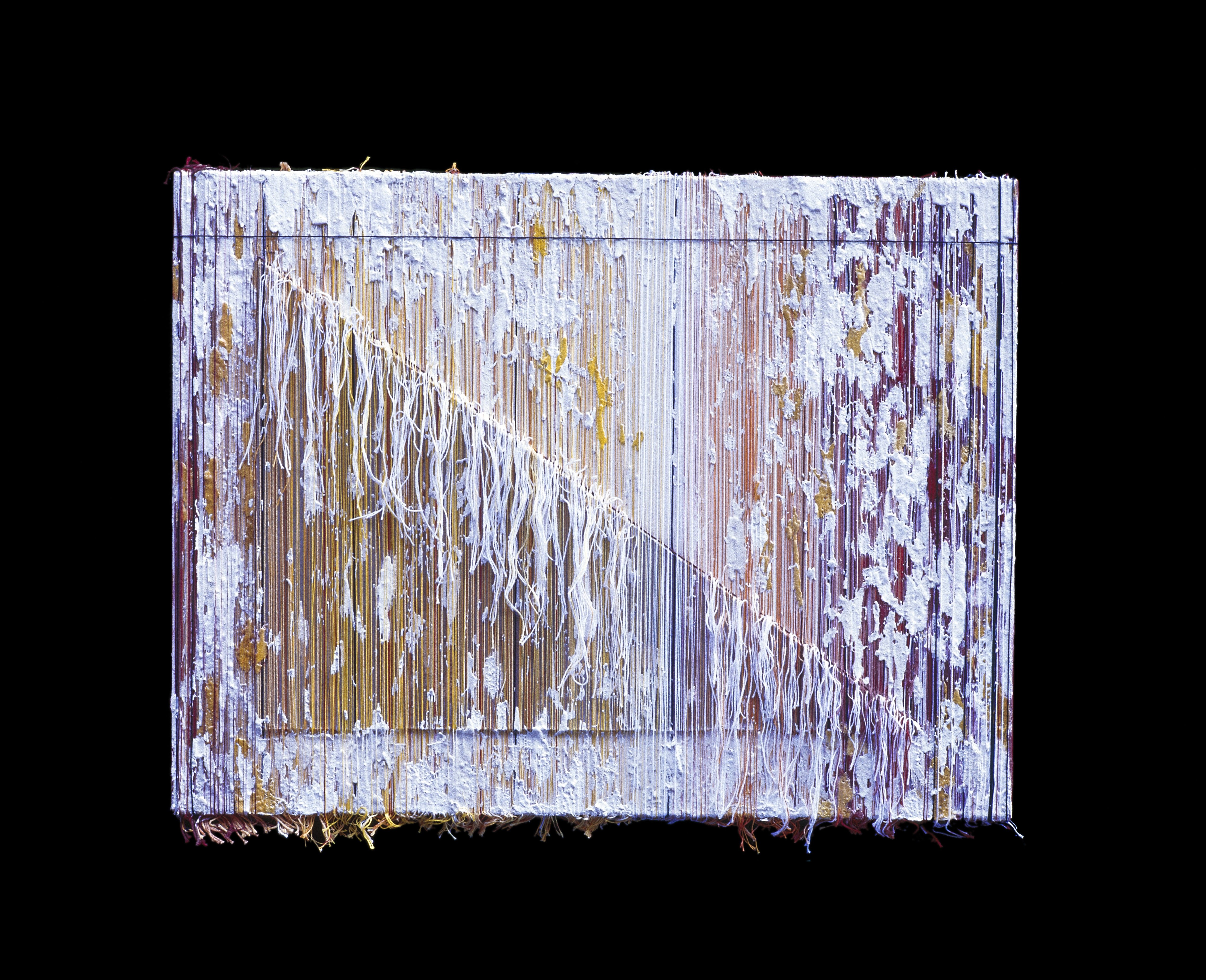
Nature is not always as it appears. Thinking and emotions play a big part in how we see nature. When Picasso said,  “I paint objects as I think of them, not as I see them”, I believe that he was saying that he intellectualizes about the subject without the affects of feeling emotions.

By distilling the basic elements of color, texture, movement and line from the landscapes of my world, my abstract frames endeavor to portray nature’s sublime order, not as ‘I think of them’ but as it emotionally feels; unspoken, indescribable and sometimes chaotic.

Ultimately, my constructed frames attempt to express “Emotional narratives with kinetic energy ”

http://www.ericgoldsteinart.com/

eric goldstein

1-What do you consider the most important thing in being an artist? 

1. For me, the most important belief I have as an artist is to endeavor to be true to myself. In that, I mean I don’t create art for art’s sake, but simply out of an innate desire to create.  It is important for me to let go of what I think is marketable and trendy and cultivate my own internal creative process and intuition.

2-When did you start painting/making art? How did you start? 

Not sure if this counts, but when I was a senior in High School some vandals broke into our school, vandalized several things, but the only thing they stole was one of my paintings from the student art gallery. It was an austere beginning but a start nevertheless.

3-How do you feel about the arts in British Columbia?

It is not unreasonable to think of British Columbia as a natural center for the arts. With it’s rich history I am not surprised at the plethora of expressive art.  One only has to attend the Eastside Culture Crawl to see that our five thousand year old artful traditions have translated into a striving art community.

4-What would you call your most interesting accomplishment as a professional artist? 

That I lived to be as old as I am.  Really!  And that I have been fortunate enough to have sustained a living being creative.

5-What advice would you give to artists looking to start their career in the arts? 

Protect your creative powers from the mundane stresses of mere survival.  Live two lives; one as a professional and the other as an artist.  Find a career that you enjoy, other than the arts, where you can make your money.  Use that money to create your art.  This way your creative processes will be free to explore without the confines of making a living. If your art sells than that’s a great bonus. In time you will know when to give up your day job.  Don’t make art to live. Live a creative life; be a creative thinker in everything you do and live a life of self-expression.

6-What is the most gratifying aspect of being an artist?

For me, my artwork is a personal journey, a kind of a catharsis that I allow to happen for myself and when the result of that process speaks to someone else, either intellectually or emotionally, that is a very gratifying experience.  Of course a ’sale’ speaks volumes to that.

7-What do you feel is the most frustrating part of being an artist? 

For an artist, your work should always be a source of frustration. Frustration is the process of working out new things.  It is the process of applying your unique experiences and talent to the thing that you are doing. If it was easy, anyone could do it.

8-Can you tell us about your studio? (describe your work space)

My studio is a 14 x 14 foot space with a large garage door that opens to a beautiful forest. Part wood shop, part machine shop, part chemistry lab and part catch-all for my kids junk, it’s the space where my imagination comes to light.  I like to think of my studio as a very powerful sanctuary where my creativity is nurtured by a collection of tools for a multitude of materials. I am fortunate enough have my studio attached to where I live so I can work any time of night either in my pajamas or three sweaters in the winter.  It reminds me of Alexander Calder’s industrial studio, where thousands of mobiles hang haphazardly from the ceiling and machinery and drafting tables cluttered the floors. It’s a place where the space above your head is as important as the floor space. Most of the time I have to move five different things to make space or to find the tool I need at any given moment.  It’s a place where my stereo is paramount.  Even though I dream of a larger space, it is a place that completes me.

9-What is your vision for your own work and the studio in the next 5-10 years? 

I should see a great deal of change in the next five years.  I know I will be moving my studio next year, but to where I’m not yet sure.  As for my work I am open to anything perhaps bigger pieces and definitely more public exposure.

Personal statement:

For the past 18 years, I have collaborated on over 35 film projects as the Director of Photography.  For me, cinematography has always been a truly renaissance art. It has required the alchemy of science, math, history, and technical skills to distill order out of visual chaos.

As with any creative ensemble, filmmaking is a collaborative endeavor.  But as a painter, I am on my own. I find that painting requires greater self-acceptance and a deeper engagement with my world.  And this time, instead of trying to make order out of the chaos, I’m embracing it and allowing it to be what it is. Ultimately, my painted frames express the same underlying concept that I strive for as a cinematographer: emotional narratives with kinetic energy.

Currently, I am using colored thread of various thickness, acrylic medium, latex paint with sand, plaster, and gold leaf, to tell a story of a- kind. By distilling the basic elements of color, texture and line from the world around me, my canvases attempt to be moving images of nature—not visible nature, but as nature feels—unspoken, indescribable and sometimes chaotic.

eric goldstein2

Biography

Eric Goldstein began his career as a teenager, sweeping floors, setting up lights and processing film in a small dark room for the renowned civil rights photographer James ”Spider’ Martin. Throughout his high school years, Eric worked as an assistant photographer to Martin whose work appeared in national publications such as Life, Time and Look magazines and today is on permanent display at the Civil Rights Museum in Birmingham Alabama. Spider Martin was very influential in establishing a life long creative pursuit for Eric.

Eric honed his skills as a fine artist at Rhode Island School of Design. While in school, Eric‘s metal sculpture, Garden Rocks, was chosen in a jury-selected show to exhibit at the Rhode Island Museum of Art. He also had a one-man show of his photography entitled the Duality of Light. In his senior year, Eric was asked to be the cinematographer on a grad student’s film. Inspired by the success of this project Eric set out to Los Angeles to earn a degree in Film and Video from the California Institute of the Arts.

Now based in Vancouver BC, Eric has had a long and productive career as a cinematographer and a fine artist. Eric has photographed over 30 features and televised movies of the week. His work has garnered several awards: An Eastman Kodak Cinematography Award for his contribution to the Oscar nominated short, Contact starring Brad Pitt, a Best Cinematography nomination at the BC’s Leo Awards for Zero Sum, and a Best Cinematography Award for How’s My Driving, at the International High Definition Festival and recently received a Gemini nomination for The Last Days of The Raven. Eric’s distinct style has been aptly termed “lustrous naturalism”.

Throughout his filmmaking career Eric has remained contemporary in the language of art with his metal sculpture, painting, furniture design and artistic fences. Presently, he is using various coloured threads, acrylic paint, metal foils and plaster to build canvases that are graphically influenced, and have strong, architectural rhythms.

A Man of Many Talents-Yves Decary

yves1yves2

About:

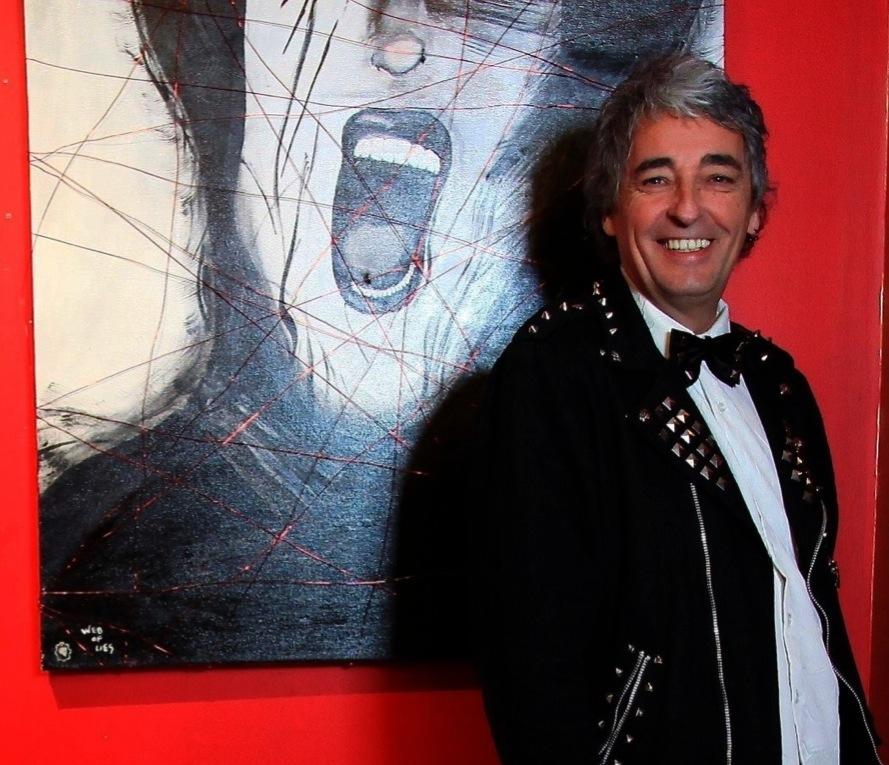
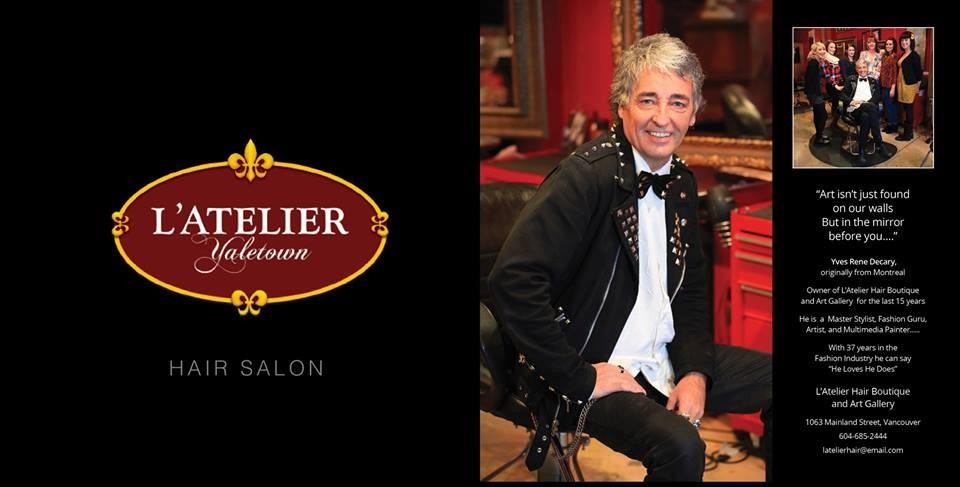
Yves Decary is not your typical salon owner. Owner of L’atelier Hair Boutique & Gallery in the Yaletown district in Vancouver, BC, this man has many talents. L’Atelier is a full service studio and gallery where local artists are able to show and sell original art work in a welcoming, edgy and vibrant environment. Clients are able to come in, be pampered by a master stylist team, but also engage with Vancouver’s artistic merit, which is evidently bustling as seen from the variety of work found at the salon. Yves not only styles, but also enjoys painting which has led to multiple live painting performances, numerous sales and an upcoming show at Roam Gallery.

yves3

Yves Decary-Interview by Alyssa Laube

How is L’Atelier Hair different from other salons?

At l’Atelier, we consider hair to be an art we are creating with scissors, paint brushes, and color. A new look for client, it is why we are different.

How were you introduced to hair styling and cosmetics?
I have always been interested in and curious about fashion because fashion is an art statement. It’s why I decided to become a hairstylist when I was 18 years old.
Why do you think it’s important that you sell local art at L’Atelier?

Our mirrors are framed like a painting and so, our client is our blank canvas. It also makes us proud to support local artists and artisans in our gallery.

When/how did you transition from selling art to creating it?

I started to paint 8 years ago and learned to express my emotion and state of mind on canvas.

To you, what is the meaning of art?

I think, if you paint with your soul, that is the true meaning of art.

As a man who is involved in both art and hair styling, where does your true passion lie?

I love edgy, raw, and sexy emotion. It is what defines me as an artist.

What do you consider your specialty?

I love to analyze people and emotion that is under the surface.

With so many unique designs and ideas, where do you gather inspiration?

My inspiration always come from my experience in life and the human beings that crossed my path.

How has your culture influenced you as an artist?

Fashion has always been a big influence on my journey of creating art.

You’ve also had a salon in Montreal, but moved to Vancouver. How would you describe that process, in a word?

Circus, because most of the time, life is like a circus!

How have you developed as an artist over the years?

Around 3 years ago, I started to mainly paint with my 3 favorite colors: black, red, and white.

What are you looking forward to most at this year’s Expo?

This year, I am looking forward to being part of the Expo again. I love the team. I’m looking forward to sharing my emotion with Vancouver, as well as the artist crowd and sharing the true meaning of art with the audience.

For more information about L’Atelier or Yves, please visit: https://www.facebook.com/groups/432888750122625/

yves4

BODY PAINT: THE FACEBOOK RESTRAINT-An Interview with Matt Huntley

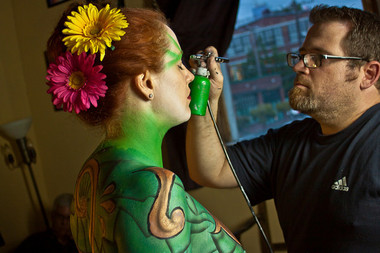
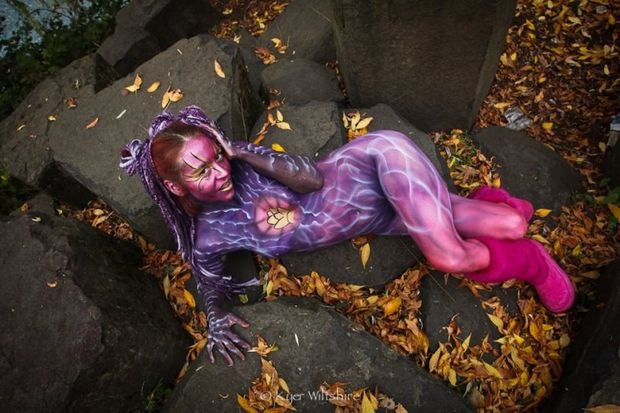
Matt Huntley is a body painter living, creating and working in Portland, Oregon. His Facebook Fan Page was recently removed due to “nude” photos of his models on his page. Though all models are covered in artistically executed paint and craftsmanship, censorship remains a key issue for body painters like Matt who are trying to push the norms of artistic expression.

 ImageImageImageImage

Interview with Matt Huntley

by Aly Laube 


About: Matt Huntley is an experienced body painter who works primarily with fantastical, horror, and special FX painting.

To see some of Matt’s work, go to: 

http://www.modelmayhem.com/mhuntley


Body painting has been a part of the Expo for a while now. Is this your first time taking part in the event and if so, what are you looking forward to?
2013 was my first time attending the event.  I met some wonderful people, and the experience was a good one.  I didn’t know what to expect, but had a blast, and placed 2nd, so I’m coming back for a second time. 


How did you get started in body painting?  
I’ve always been an artist, and got in to special effects.  After many years doing SFX and theatrical makeup, I got tired of the same work over and over.  How many zombies does the world actually need?  So I started doing body painting, and love every minute of it. 


How did you receive your training?  
I’m mostly self taught.  I was an art major when I first went to college, but quickly changed career paths.  I did intern in the Special Effects field for a few months, and received a decent foundation, but over all I just research various forms of art, talk with painters, sculptors, and makeup artists.  I practice all the time with new products, various paint brushes, and airbrushes.  


What is the best thing about working in body painting? 
I like turning the human canvas into a piece of art.  The human form is already such an amazing art piece, so to use it to create is really the best part of body painting. Also, I do like that it’s temporary (this means I don’t have stacks of canvases piled up in my studio.)


The art that you do is very creative. How do you experiment with your work? 
I’m always testing new techniques and designs.  I test new brushes and new products.  I test to see which products work best with each other and how various paints lay on top of each other.  I also check my designs against what has already been done, and if I’ve duplicated someone else’s work, I try to change my design when I can.  When working with photographers or models, I take their input on what they want the design to look like, and I try to think of a way to get that look as well.   I’m always pushing myself to grow as an artist in all aspects of my art.  


What inspires you? 
Everything.  People, shapes, nature, other artists.  I get inspired to create different things every day.  Sometimes this becomes overwhelming, so I keep a book that I jot down my ideas in. 


How have you evolved as an artist over time? 
My work has become cleaner, bolder, and more detailed.  My use of time has improved, and I’ve become more confident with my designs.


Did you always want to go into body painting? 
Actually, I wanted to be an art teacher. After years of exploring all forms of art, I happened into body painting and fell in love with it.


A lot of the work you do is very fantastical. Is it your own ideas or others that inspire you in this area? (i.e.: movies, books, art)
Most of the work I do are my ideas.  I do also collaborate with models, and photographers on a basic concept, and they give me artistic freedom.  Some of my work might also be an interpretation of some other art work.  I have painted a person and a horse, based on work from artist “Olivia De Berardinis”, and of course as a huge Star Wars fan, I have also done a few pieces that follow that genre.


Many different models are used for your artwork. How do you think the model is important to the piece as a whole?         This is a tough question.  I have designs that are designed around very specific models, and then I have some designs that are designed around body shapes. (tall, short, petite, curvy, etc).  That being said, when I’m designing a new painting I will ask the model what his/her favourite colours are, I look at skin tone, eye colour, hair colour, height, length of torso, legs, etc.  the shape of the model is important to the design, and the design is important to the model.  If you paint a model with a design she loves, she will make that design hers and work it. That being said, some designs are meant for a single shot, straight on, and the model becomes less important.  For instance, if I’m hiding a model in a mural, or against a back ground (camouflaging them), for this type of painting the most important part is the placement of the model and lining up the painting. 


How is body painting different than other forms of art?
Bodypainting is temporary.  First and foremost.  Also, what might take an artist painting on canvas 2 or 3 days (or weeks) a body painter must do in a few hours.  Our canvas is alive, they move, they stretch.  The movement of a foot can change the lines you’ve painted on a cheek… so taking all of that into consideration is very important.


You’ve painted on both men and women. What do you consider the important differences? How about similarities? 
Differences? Body hair.  When a man is going to be painted, they will shave or wax their entire body before. Rarely will a female model shave or wax her entire body, and then they will make a comment about body hair.  Every model, “every single person”, has body hair.  It’s just biology.  Most of it is light and small and can’t be seen… but you hit that with some paint, and from up close this can be seen. Nudity.  Most female models have no problem with being naked for a painting, whereas only a few male models are comfortable enough to get fully nude.  Body shape.  Simply put, women have more curves, breasts, hips, legs, they are curvier and softer.  Similarities? The initial reaction to the paint.  Be it brush, sponge or airbrush, their reactions are the same.  Most have the same questions about how one gets into bodypainting, as well as how to clean up, so I would say the differences are mostly physical and the similarities are mental. 


How did your home life/childhood impact your decision to become an artist?
I’ve just always been an artist.  I can’t remember not being an artist.  I’ve always drawn and been pulled to various art.  My art drove my imagination and my imagination drove my art.  Some people are inspired by music, or theatre, or sports, and I was inspired by colour, shape, lines, and creating.


What do you hope to explore as an artist in the future?                                                                                                               I’m planning my first trip to the “World Bodypainting Festival” in Austria, June/July 2014.  I am hoping to compete, but at the very least paint. I’m hoping to get to work at conventions, as well as do more “Larger” production paintings involving multiple photographers, costumers, and hair stylists.  


Image


Image

 Read Matt’s interview with the Oregon Times for details about his recent run in with Facebook:  

“Portland body-painting artist fights Facebook over nude photos”

http://www.oregonlive.com/entertainment/index.ssf/2014/01/portland_body-painting_artist.html

Adelle Airey shows for the first time at Art World Expo 2014

ImageImage

Interview With…

Adelle Airey

by Alyssa Laube

About: Adelle Airey describes herself as a “self-taught artist, typically creating acrylic paintings of single flower blooms or plant life covering the entire canvas.” To learn more about Adelle, go to http://www.facebook.com/AdelleAireyArtworks


Is this your first time at the Art World Expo? What are you looking forward to?

Yes.  I am looking forward to having my work on public display for the first time.


How did you get started in art?

I have always loved to draw and create things.  My grandmother liked to paint and she encouraged me to paint even if it was just as a hobby.  I was recognized in my senior years of high school, as Seaquam Secondary’s “Outstanding Senior Art Student” and commissioned to design and paint a hallway mural.  My pencil & ink drawings and water colour paintings were proudly hung around my parent’s house.  Many of my early pieces were given as gifts to special friends.


How were you influenced as an artist by your heritage or home town?

Our family lived on a small non-working farm in Delta in the70s.  Growing up surrounded by colourful things in nature and interesting personalities of animals, has definitely influenced my art.


Who was your main inspiration growing up and how has it changed from then?

Artists like Patrick Nagel and Ty Wilson have probably made the biggest impression on me as an artist.  I admire their simplicity of style and use of contrasts and colour.


Many of your paintings are of flowers. Is there any specific reason for this?

I still have the first photo I took with my parent’s camera.  I was 9 years old and it was of a rose in our garden.  I appreciate the wide variety in plants and flowers, and they allow for artistic expression.


What do you consider your “big break”?

Art World Expo 2014 !


How have you developed as an artist, both professionally and personally?

I realize I cannot be afraid to experiment.  Researching techniques and ways to improve as a painter may not always lead to a “good” piece, but that is ok.  Personally, I have “developed” in facing my fears and gaining confidence in myself as an artist.


How did you receive your training?

I am a self-taught artist with no formal training.


You also create sculptures. How did that start?

I started a craft project over the winter of ‘93. My first Paper Mache sculptures were a decorative bowl and a prickly pear cactus.  After showing a co-worker what I had made, she asked if she could commission a piece for her home.  The sale of that piece quickly lead to another 5 commissioned pieces.


Have you ever gotten “Artist’s Block” and if so, how did you deal with it?

I didn’t do any art for a long time.  Don’t know if that was a “block” or just letting life get in the way of something I really needed to do.  I find setting a goal or deadline for a piece helps motivate me.  I try to work on my art only when I’m in the mood”.


What is your favorite (and least favorite) thing about being an artist?

Fav: I get a lot of satisfaction when I am finished a piece and it turns out the way I envisioned.  Least fav: criticism that is not constructive.


Did you always want to be an artist? If not, what did you want to be and when/why did you change your mind?

Yes.  I just didn’t really know what kind.  I thought about being a graphic artist; makeup artist; or interior designer.


Globe Trotting Photographer David Naman

Interview With …
David Naman

by Alyssa Laube
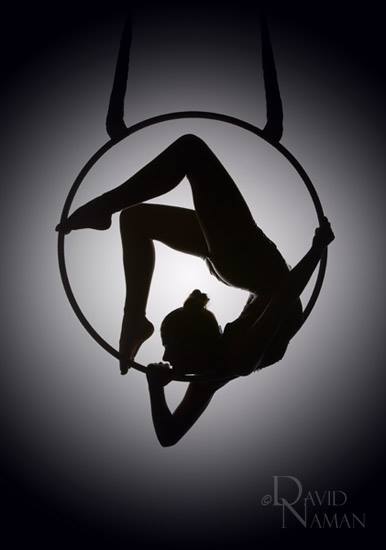
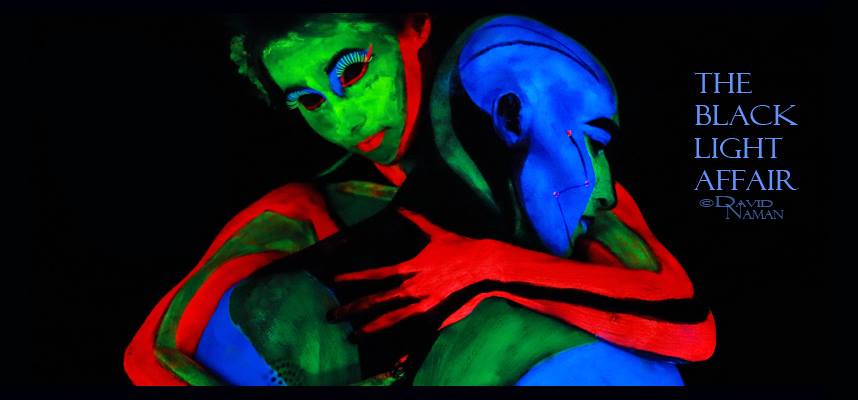
About: David Naman is a cutting-edge, award-winning photographer whose primary focus is on nature and nude images. His work can be viewed on:
http://hypnoticphoto.ca/

davidnaman

How were you introduced to photography?
I started taking beauty pictures of my other half. We showed a couple of friends and they really liked them and wanted some images taken of them. I wanted to know more about photography so I took some courses.
How were you influenced as an artist by your heritage or home town?
I am a born and raised Vancouverite and every day we see natural beauty surrounding our city.
Who was your main inspiration growing up and how has it changed from then?
I never knew I was an artist when growing up, so I never had a role model, but when I look back I remember sketching figures in my spare time.
What do you consider your greatest accomplishment?
Winning a Gold Medal in the ‘TRIERENBERG SUPER CIRCUIT’ 2013, which is one of the most prestigious Photography Award shows, got me on the Global map!
What is your favorite art gallery in or outside of Vancouver?
The Museum of Modern Art in N.Y.C.
How do prefer to experiment with your photography?
I always want to create something extraordinary, unique and brilliant, so I use many techniques I have learned over time.
Simply put, where do you get inspiration for your art?
Life inspires me.
 How do you feel about the phrase, “A picture is worth a thousand words”?
You definitely can put a whole story into a picture but the way the viewer interprets the image can be different.
What is your favorite thing about being a photographer?
To capture the beauty, elegance, power, and grace in nature, wildlife and human form.
 Do you currently have a favorite artist or collection?
There are many amazing artist but I have come across one photographer recently that has really got my attention, Daniel Ilinca.
Describe the Vancouver art scene in three words.
Alive, diverse, and budding.

Visit David at Art World Expo 2014 on May 2, 2014. David’s photography has also been chosen for the AWE 2014 advertising campaign.

davidnaman2

davidnaman3

Award Winning Photographer-Chris Collacott

Interview With…

Chris Collacott

by Alyssa Laube

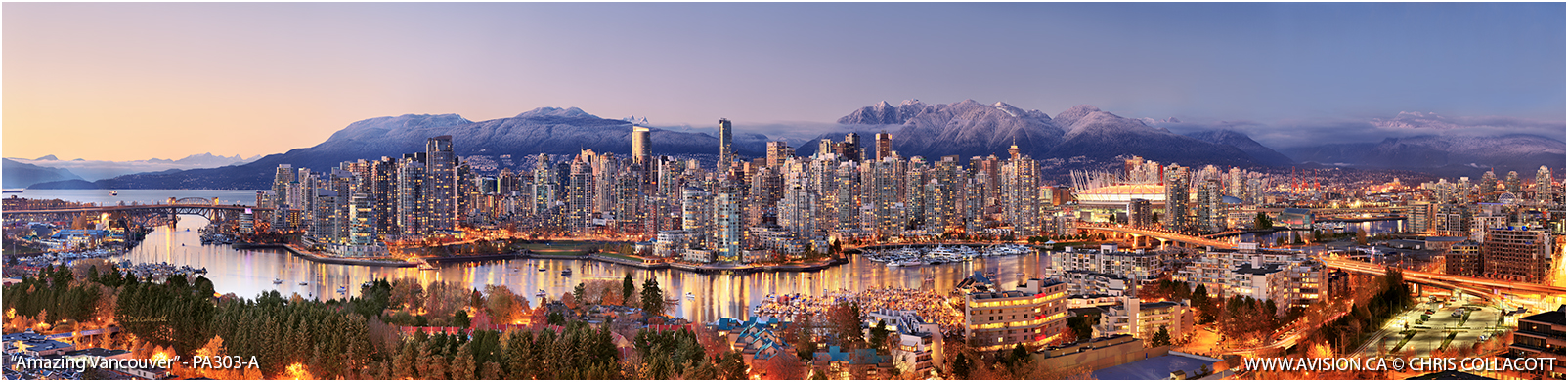
About: Chris Collacott is an award-winning photographer who specializes in panoramic images. Among his most successful pieces are the photos of our  very own Vancouver. For more information on Chris, go to http://www.avision.ca

Chris Collacott

Chris Collacott

How did you get started in photography? Did you instantly have a passion for it?

I think I’ve always loved taking images with a camera – since I was a child.  It was in 2008 when I purchased my first DSLR, and my passion grew with the fact that I had creative control over the end results of the image capture.  My passion really grew from that point.

What do you consider your “big break”?  

My big break would have happened in 2010 at which time I started to sell my work in volume.  That allowed me invest in better tools and recognize that I should continue to pursue my passion more seriously.

How have you developed as an artist, both professionally and personally?  

Honestly, I still have difficulty calling myself an ‘artist’.  I grew up excelling in math, science and technology – and even garnered a 17 year career in technology.   My passion is capturing our amazing landscapes and cityscapes to the best of my ability.   I don’t spend much time thinking about myself and how I am ‘developing’ as an artist.  I just go out there and do it.

What was the last artwork that had a lasting effect on you? How so? 

Unlike a painter who may spend months on a single piece – my work is a progression of images and features of locations and moments in time.  I see them as a collective group for certain areas and places that I capture, and therefore don’t have a specific “work” that affects me more than another.   I do know that in order to capture my images, I have experienced and been to amazing places that are beyond words – the experience of being in those places are what has a long lasting effect on me.   It affects me by reminding me that our time is very small compared to geological time.

Recently, you won a 2013 Epson International Photographic Panorama Award, among others. How does that feel?

Like any art, there are people who like it, and don’t like it as art is highly subjective.  Therefore, always feels great to know that other peers in my industry recognizes and appreciates my work.

What is it about this city (Vancouver) that inspires you?  

As a landscape and cityscape photographer – everything!  Honestly, I don’t think I would have found this passion or career unless I lived in Vancouver.  It is the natural beauty of our city and geographic surrounding that has inspired and pushed me to get out there and do what I love to do.

How has the development in technology impacted your work as a photographer?  

Yes, of course.  Having worked in the technology sector for 17 years, I am a technical person in how I perform most of my daily tasks.  I am often a early adopter with technology and that also influences my passion of photography.   I don’t think I would have gotten into photography unless it was digital – I could never consider using film cameras.   So technology is an integral part of my tool kit in my work.

Your use of panoramic photography is well-known. What motivated you to start taking panoramic photographs, and why do you believe that they are so stunning? 

I’ve always love stunning and ultra-wide landscapes.  When I started taking photos long ago with a point and shoot camera, I just felt I could never fit everything in a single shot, so I simply moved the camera over a bit, and took another photo to “extend” the view.   Also, I felt that taking a single shot did not capture all the detail I wanted in the landscape as my eyes saw.   That motivated me to start taking panoramic images – and by taking more than a single photo, taking multiple images increases the overall detail of the image and resolution.   What makes some of my work “stunning” is simply the clarity and detail when printed large.   Some of my panoramic are gigapixel sized images – so even if printed 12 feet wide – the detail and clarity is still there.  Which would be impossible with a single shot.   The images I capture also exceed the image quality of a single shot from a medium and large format film cameras – hands down.

Where do you get inspiration for your photography?

I get my inspiration for my work from hiking and being outside.   Our location here in British Columbia is saturated with beautiful landscapes – and it does not take very far to find inspiration.  

Have you ever gotten  “Artist’s Block” and if so, how did you deal with it?  

I have yet to experience this.   My problem now is lack of time to get out and shoot!   I have a young family which I love spending time with and is obviously my main priority :).

What was the first piece of art you sold?  

The first print I sold was in 2009 called “Urban Reflections” – a single shot of False Creek.

What is your favorite (and least favorite) thing about being a photographer?

The favorite thing about being a full time photographer is that I get to enjoy doing what I love as a career.  Getting outside, hiking mountains and capturing amazing scenes.   The least favorite part is having to wait for the right light and weather to get those shots ;).

With two small children at home, it must be challenging to balance work and family! How do you go about doing it?

Time for me is the limiting factor in everything – there just is not enough of it in the day!   From there, my family is the priority for my time spent (obviously) followed by my passion of photography.   While there are challenges – it all seems to work out in the end.

One of Chris Collacott's images of Telus World of Science. He will be exhibiting at Art World Expo 2014 for the fourth year in a row.

One of Chris Collacott’s images of Telus World of Science. He will be exhibiting at Art World Expo 2014 for the fourth year in a row.

Making Sweet Social Connections outside of the Salon-Meet Tres Bon Beauty

Interview With…

Diane Travis From Tres Bon Beauty

Interviewed by Alyssa Laube

About: Meet Diane Travis, the owner of “The Local Hair and Beauty Salon That’s Making Sweet Social Connections,” Tres Bon Beauty. For more information on Tres Bon Beauty, visit http://www.tresbonbeauty.com/

How would you describe your past experience with the Art World Expo?

This is my 3rd yr. at Art World Expo, Last year, I had business from it and it was worth it financially for me.

How did you get started and trained in beauty?

I entered hairdressing school the year I graduated from high school. I trained at Comer and Doran Hairdressing Method in New Westminster.  I upgraded skills by taking many colour courses, seminars and conferences along the way.

Did you know instantly that you wanted to pursue it?

I believe I was born to be a hairstylist.  After constantly looking to comb my mother’s and grandmother’s hair and begging my mom to buy more makeup, the family said-I think she’s going to be a hairdresser!  And the rest is history!

At Tres Bon Hair & Beauty, you emphasize interacting personally with clients. Is there a reason for this, or is it simply in your nature?

I am personal by nature, but the reason I like to interact helps me to create the best result for their lifestyle.  I help take the stress out of beauty for them.

Other than personal service, what makes Tres Bon different from other salons?

Tres Bon creates a smaller space where clients can relax and feel pampered.

How did your childhood, family, and hometown influence your work?

My childhood taught me hard work, good values, and the importance of family.

You offer a variety of services. What do you consider your specialty?

My favourite service is what I call “The Petite Makeover” – Ladies cut/color/few hi-lites/style and easy makeup.

How have you developed as a professional?

I would say that personal and professional are one in business. I consider personal growth essential to be able to give people the service they absolutely need and want.  I still do what I do, just change the way services are given.

As someone with experience, do you have any words of advice for new business owners?

My advice to new business owners: follow your passion and talk about it clearly and simply. Define your uniqueness, and ask for what you need and help others.   You cannot do it alone!  Make your life easier, not harder. And have a wonderful time!

What is your favorite (and least favorite) thing about working in beauty?

I get to make people look good and feel good. My least favourite thing is the client who doesn’t get it!

Do you have a favorite memory from working with Tres Bon Hair & Beauty?

My favourite memory is the story, the many stories, but the many compliments I get regarding how I make them feel and look.  This is why I do what I do.Imagetresbon-kara

“Mass Produced Art Ain’t Nothin’ but Cheap Imitation”-Artist Gayle Arnold

Gayle Arnold

We’ve known artist Gayle Arnold for several years. She is an active painter in the Vancouver area, works from Port Coquitlam and participates in all sorts of shows as well as teaching private students. In her response to sharing an interview about her art with the Art World Expo blog, she submitted this piece highlighting what she believes about the Art World today.

The beginning of this video starts out with close-ups of various paintings by Gayle Arnold. They are abstract up close but from a distance they are clearly described images. The music was performed by Gayle Arnold and her partner Justin Symonds, who perform together as The Strangest Days.

“Like” Gayle – http://www.facebook.com/GayleArnoldTSD
The Strangest Days – http://www.reverbnation.com/TheStrangestDays
“Like” TSD http://www.facebook.com/GAJFTSD

For more information about Gayle Arnold, please visit her site:
Gayle’s portfolio website – http://www.gaylearnold.com

Interview with Artist Elaine Kao-Power Ranger at Heart

Elaine Kao Kao_Elaine_2014_2 Kao_Elaine_2014

Founder of Art World Expo, Monika Blichar goes into interview mode with AWE 2014 Exhibitors to search for the meaning of art, the stories within each artist, and the inspirations behind creativity to be found at Art World Expo 2014 in Vancouver, BC. Presenting Elaine Kao, Dino & Panda Inc. 

Elaine Kao~Power Ranger at Heart

As a returning artist from Victoria, BC, Elaine has demonstrated growth and artistic transformation since participating for the first time in 2012. Her art and style is not only eye catching, light and fun, but the message that she holds behind the creativity she pours out into doodles, canvas and merchandise is by far the best part of why it is so important to support the arts in our regions as well as globally. Quoting from her fan page which now has over 54,000 fans on Facebook, her motto is “Art work dedicated to making you smile”.  Simply perfect.

1) When did you start making art?

My parents say I used to draw snowmen when I was maybe 3 or 4 years old (holding the crayons with a fist). My first big inspiration for wanting to be an artist was after watching Sailor Moon (a Japanese animation) when I was in grade 1. After that I spent most of my time drawing the characters and became really interested in the Japanese anime style of art. I always enjoyed art class throughout grade school. In grade 12, my art teacher let me do my own thing in the back of the room because he knew I could do the exercises he was making everyone else do. That was the first time I painted on canvas with acrylics. Then, against the will of my parents, I applied and got accepted into the Visual Arts program at the University of Victoria.

2) How do you feel about the art scene in our province?

I don’t know about the rest of the province, but I always find that Vancouver Island, and Vancouver have lots of exciting things going on. The art scene is definitely growing every day as young artists are being given more and more opportunities to show and share their work and love of art. I especially love events that bring the community together. One of my favorite events is the annual Art Gallery Paint-In (Victoria, BC.)

3) Describe your goals for your art practice.

My goals in art and everything is to become better and better, and perhaps along the way discover new skills and talents. Recently I’ve been really interested in the 3D painting of Riusuke Fukahori and Keng Lye. I’ve been busy with school so I haven’t had a chance to experiment with resin and painting 3D yet, but one day! On my Dino & Panda fanpage my tagline is “Artwork dedicated to making you smile.” I’d say that’s my biggest goal and motivation when I’m making art. Of course, I’m only human, and I have some sad days which gets translated into my artwork, but I think my fans can connect with those moments too, because I believe I’m not the only one dealing with the curve balls life throws.

4) How has Social Media helped your art career? (specifically your 54,000+ fans on Facebook)

At first, I was just using social media to share my artwork and random doodles with my friends but it quickly grew into an awesome way to spread my work even farther…all the way around the world, in fact! I think it’s the greatest motivation to have people from all over the world connecting with my artwork and cheering me on even when I’m down  I know everyone says this, but I have the best fans ever! Fans sometimes send me messages about commissions or drawing requests which I’m happy to work on. Other fans message me just to tell me their story about how one of my drawings may have held special meaning for them and made them feel better after a bad day. Without social media it wouldn’t be possible to connect with so many people.

5) Do you have any special talents or interesting goals you would like readers to know about you?

I’ve been playing the piano since I was 6, and the ukulele since grade 6. I actually teach piano and ukulele! I’m also practicing guitar on my own. I love to sing and I have a bunch of cover songs on Youtube in a few different languages. Other than music, I am a language nerd and there are 7 languages I want to become fluent in (Mandarin, Korean, Japanese, Italian, Spanish, French, and Greek.) I also speak Cantonese 

6) If you could do anything you wanted, what would it be?

I would be a Power Ranger. Other than that I’m pretty much doing what I want right now, working hard on becoming an awesome teacher!

7) Who inspires you to make art?

Everyone, everything, everywhere and anywhere. From real people to fictional characters, everyone has a story to share and there’s bound to be something interesting!

8) Where can readers purchase your art?

I haven’t had time to look into establishing an online store, and I also don’t have much merchandise yet, but if anyone is interested they can just send me an email, or message on the fanpage. Everyone is welcome to visit me at the Art World Expo, of course! Become a fan of my Dino & Panda and I’ll post updates whenever I will be appearing in art shows!

9) Why do you feel art is important to the individual and to society?

I think art is important to the individual and the society because it’s a way to express opinions, and feelings which may be hard to put into words. Personally, art has been a very important aspect of my life because I’m inherently introverted and I used to be the shyest person you could ever meet. Without art and music as outlets I might as well have been invisible, letting everything, good and bad, build up inside until I explode and disappear. It’s important to understand that you are a valuable person within a society and your story is worth sharing. No one is ever really alone, after all! Besides, creating art is, in most cases, the least destructive thing a person can do when dealing with anger, frustration, and all those negative emotions. Even if a person claims to be the most artistically challenged person in the world, they can still appreciate and connect with the visual stimuli they encounter in their surroundings.

10) Lastly, what do you like about being in the Art World Expo showcase?

I love being a part of the Art World Expo because I get to see many different styles and disciplines of art from many artists. It’s both inspiring and encouraging. Because I’ve been in the Art World Expo for a few years now, it’s exciting to see every aspect of the show improving each year.

To learn more about Elaine and Dino & Panda Inc., visit her fan page on Facebook:

https://www.facebook.com/Dino.Panda.Inc